
INTEGRATED CAMPAIGNS AND GTM ORCHESTRATION
Integrated Campaigns That Create Pipeline Momentum
Unify digital, outbound, partner and field motions around the moments that move pipeline
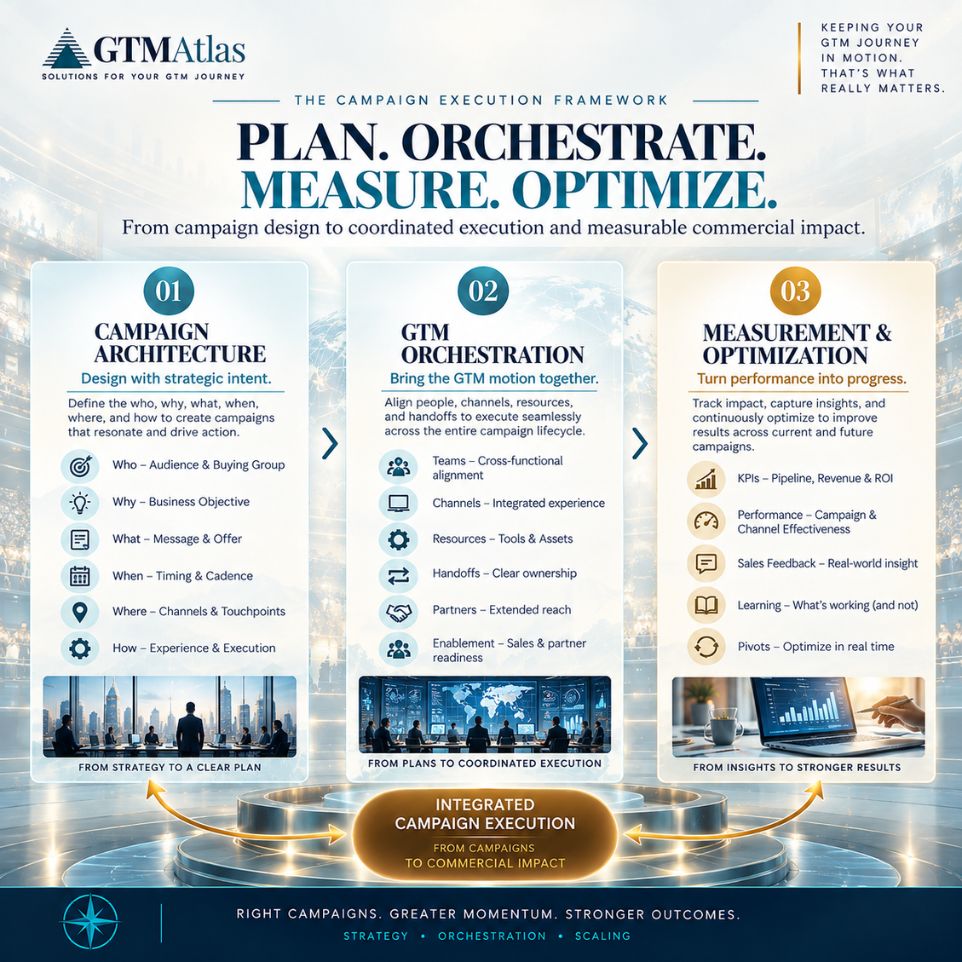
Orchestrating Integrated Campaigns That Convert Engagement into Pipeline
Marketing leaders translate business priorities into coordinated market execution.
Each campaign requires clear decisions on audiences, activities, channels, teams and how investment connects to business outcomes. Campaigns become more effective when they operate from a clear market architecture and strategic intent.
The opportunity is to qualify the campaign before expecting it to qualify the lead.
Success comes from selecting the right campaigns, rigorously evaluating them, thoughtfully designing them and orchestrating them around a shared business objective.
GTMAtlas helps marketing leaders establish a connected campaign system that brings strategy, audience intelligence, messaging, channels and execution together.
Through structured campaign selection, integrated execution frameworks and continuous optimization, we help teams focus investment, coordinate resources, and create measurable commercial impact.
The outcome:
More deliberate campaign investment.
More coordinated execution.
Stronger visibility into marketing's contribution to growth.
MAKE EVERY
CAMPAIGN COUNT
Qualify the campaign before expecting it to qualify the lead
The right campaigns. The right coordination. The right outcomes.
Architect Invest with intent, not habit.
Orchestrate Execute as one GTM motion.
Optimize Prove marketing's impact on revenue.
Connected Campaigns. Coordinated Execution. Measurable Market Impact.
ACTIVATE
From Coordinated Execution to Pipeline Progression
Bring the campaign to life. Move the buyer journey forward.
Integrated execution connects digital, outbound, partner, and field motions around a shared plan. That coordinated motion depends on teams working from shared priorities, connected decisions, and a common execution rhythm.
Connected Execution
Digital, outbound, partner, field. One plan.
Buyer Engagement
Orchestrated around buyer needs.
Executive Engagement
Roundtables. CABs. Peer exchanges.
Pipeline Progression
From engagement to opportunity.
Coordinated Engagement. Meaningful Buyer Progress. Stronger Pipeline Momentum.
ORCHESTRATE
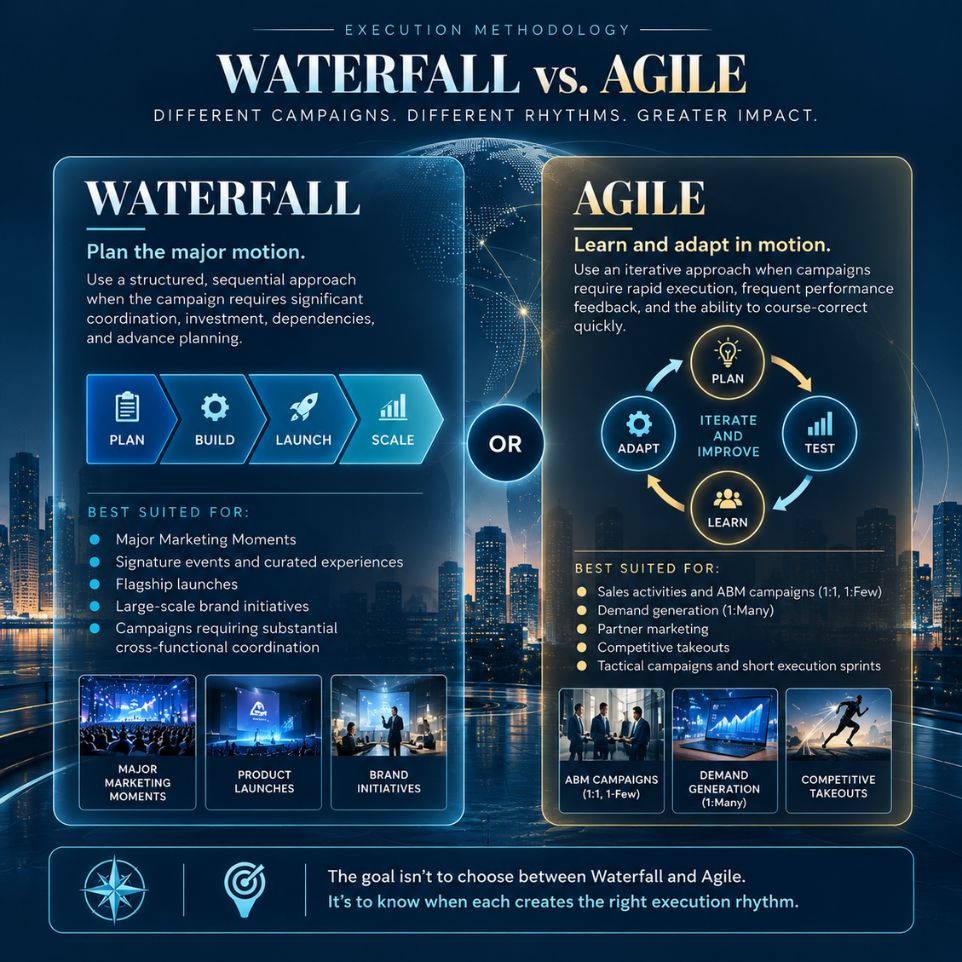
Not Every Campaign Should Move the Same Way
Match the execution methodology to the campaign’s scale, complexity, and velocity.
We align the execution methodology to what each campaign requires to ensure the right structure, speed and coordination for market impact.
Two Methodologies. One Orchestrated System.
WATERFALL
For high stakes, high dependency campaigns.
Enterprise launches. Tier 1 ABM. Industry moments.
AGILE
For high velocity, iterative campaigns.
Vertical plays. Partner motions. Test and learn pilots.
We help you orchestrate both, so you deliver big bets with precision and move fast where velocity creates advantage.
BETTER TOGETHER
Precision Meets Orchestration
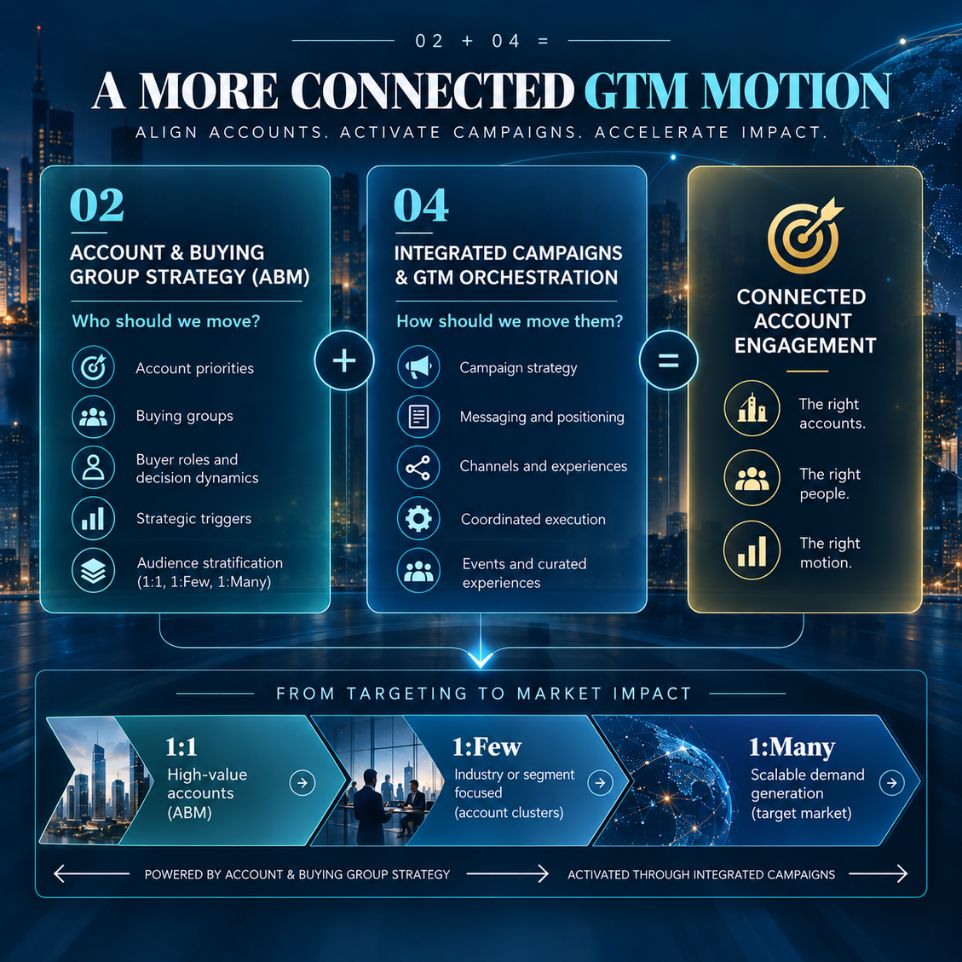
Account strategy creates direction.
Campaign orchestration creates momentum.
A beautifully executed campaign still misses the mark if it reaches the wrong accounts. GTMAtlas connects account and buying group intelligence with campaign orchestration to create a precise and powerful GTM motion
COMPOUND
Turn Campaign Learning into the Next Advantage
Capture what the market teaches you and use it to strengthen the next campaign.
Campaigns create the greatest value when performance insights are captured, applied, and scaled. We help you continuously refine your campaign strategy, strengthen execution, and compound results over time.
That learning becomes even more valuable when connected to the broader GTM journey. Explore the GTMAtlas Atlas Series for executive perspectives on the strategic decisions that shape momentum from market clarity to execution.
Measure
Track performance against campaign objectives
Learn
Surface insights from engagement and market feedback
Adapt
Refine strategy and execution based on what works
Scale
Apply proven approaches across accounts and campaigns
CONTINUE
What's Next?
Next Step: Turn Market Engagement into Revenue.
You have orchestrated the right objective, campaign, channels, messages, and teams into one market motion. Now turn that market engagement into buyer progression. Equip your revenue teams to turn interest into conversations, conversations into opportunities, and opportunities into conversion.
01
GTM Strategy & Market Architecture
02
Account and Buying Group Strategy (ABM)
03
GTM Team Alignment
04
Integrated Campaigns & GTM Orchestration
05
Revenue Enablement & Conversion
06
GTM Intelligence & Optimization
One Journey. Six Capabilities. Continuous Momentum.
Frequently Asked Questions
UNDERSTANDING THE ARCHITECTURE
What is Integrated Campaigns & GTM Orchestration?
Integrated Campaigns & GTM Orchestration is the discipline of connecting campaign strategy, audience intelligence, messaging, channels, teams, experiences, and execution around a shared business objective.
Rather than treating campaigns as a collection of independent marketing activities, GTM orchestration brings the relevant GTM functions and market-facing motions together so they work as one coordinated campaign. This includes digital, outbound, partner, field, events, executive engagement, and other relevant experiences across the buyer journey.
The objective is not simply to execute more activity. It is to create coordinated market engagement that helps move buyers forward, supports pipeline progression, and creates measurable business impact.
What exactly is GTM Orchestration vs. traditional campaign management?
Traditional campaign management often focuses on planning and executing the activities within a campaign: content, email, paid media, events, outbound programs, and other tactics.
GTM orchestration goes further by connecting the decisions and dependencies across those activities. It considers the campaign objective, target audience, messaging, channels, teams, resources, handoffs, buyer journey, and market feedback as parts of one coordinated motion.
The distinction is ultimately about coordination. Campaign management asks, “Are we executing the campaign?” GTM orchestration asks, “Are the right people, channels, messages, experiences, and teams moving together toward the same objective?”
Why should a company qualify the campaign before expecting it to qualify the lead?
Because lead quality is influenced by the quality and relevance of the campaign that creates the engagement.
GTMAtlas introduces the concept of Marketing Qualified Campaigns (MQCs) as an additional qualification point before lead qualification. The premise is straightforward: rigorously evaluate the campaign's business objective, audience, execution requirements, resources, and readiness before investing heavily in market activation.
A campaign that is strategically relevant, appropriately targeted, operationally feasible, and designed around a clear objective has a stronger foundation for generating meaningful engagement. MQC qualification does not guarantee lead or pipeline performance; it creates a more disciplined basis for deciding which campaigns deserve investment and execution.
How does ABM connect with Integrated Campaigns & GTM Orchestration?
Account strategy creates direction. Campaign orchestration creates momentum.
Account & Buying Group Strategy identifies the accounts, buying groups, buyer roles, decision dynamics, and strategic triggers that matter. Integrated Campaigns & GTM Orchestration determines how to engage those audiences through the appropriate campaign, message, channel, experience, and execution motion.
This relationship can operate across different levels of audience focus:
1:1 for high-value accounts,
1:Few for focused industry or segment account clusters, and
1:Many for scalable demand generation.
Together, the two capabilities connect who the organization needs to move with how it intends to move them.
What makes an integrated campaign successful?
A successful integrated campaign begins with a clear business objective and connects the decisions required to achieve it.
The right objective.
The right campaign.
The right channel.
The right message.
The right team.
When those elements work together, campaign activity becomes coordinated market engagement rather than a collection of disconnected tactics.
The ultimate goal is to create a campaign that can move from engagement to pipeline to revenue while continuously learning from the market and strengthening the next campaign.
That is what turns campaign execution into a coordinated GTM motion.
PUTTING THE MODEL INTO MOTION
When should a GTM team use a Waterfall vs. Agile campaign execution approach?
The choice should depend on the campaign's scale, complexity, dependencies, investment, and velocity, rather than on a blanket preference for one methodology. GTMAtlas uses Waterfall and Agile as different execution rhythms for different campaign circumstances.
Waterfall is appropriate when a campaign requires substantial advance planning and coordination, such as major marketing moments, flagship launches, signature events, large-scale brand initiatives, or programs with significant cross-functional dependencies. The motion typically progresses through Plan → Build → Launch → Scale.
Agile is better suited to campaigns where rapid execution, frequent feedback, and course correction are important, such as demand generation, ABM programs, partner activities, competitive takeouts, sales activities, and shorter tactical campaigns. The motion becomes Plan → Test → Learn → Adapt → Iterate.
The goal is not to choose one methodology over the other. It is to match the execution rhythm to what the campaign requires.
How do you measure GTM orchestration?
GTM orchestration should be measured at multiple levels rather than through campaign activity metrics alone.
At the engagement level, teams can evaluate meaningful audience engagement, account and buying-group engagement, channel performance, and progression through the buyer journey.
At the pipeline level, measurement can include qualified opportunity creation, pipeline progression, conversion, and the contribution of coordinated campaign activity to revenue opportunities.
At the business level, organizations can connect campaign performance to revenue, growth, market expansion, and brand and market presence where appropriate.
The GTMAtlas approach also adds a learning dimension: measure performance, surface what the market is teaching the organization, adapt strategy and execution, and apply proven learning to subsequent campaigns.
The objective is not simply to report what happened. It is to create a system in which performance insights improve the next campaign.
How do integrated campaigns support both short-term pipeline and long-term brand building?
Integrated campaigns do not have to choose between immediate commercial objectives and long-term market presence.
Different campaign motions can serve different roles within the broader GTM system. Some are designed to accelerate opportunities and pipeline progression; others create sustained audience engagement, strengthen market relevance, build recognition, deepen relationships, or create future demand.
The orchestration discipline is connecting these motions around the organization's strategic priorities while ensuring that each campaign has a clear objective, audience, message, execution model, and measurement approach.
This allows marketing leaders to manage the dual mandate of creating near-term commercial impact while building longer-term market value.
What types of campaigns can GTMAtlas help organizations orchestrate?
GTMAtlas helps organizations orchestrate a range of campaign motions, aligning each campaign to its business objective, audience, market context, and execution requirements. These include Always-On Campaigns, Major Marketing Moments, Partner Activities, Industry & Geographic Campaigns, Competitive Takeout campaigns, and Sales-Activated Campaigns.
Each campaign is designed around the execution approach that best fits its scale, complexity, velocity, and resource requirements. Waterfall and Agile methodologies provide the flexibility to create the right execution rhythm for each campaign.
The focus is deliberate campaign selection and coordinated execution. GTMAtlas brings the right channels, messages, experiences, and teams together around the opportunity, creating a connected market motion designed to drive meaningful engagement, pipeline progression, revenue, and market impact.
How quickly can GTMAtlas develop and launch an integrated campaign?
Integrated campaigns can move from strategy to launch within 4–8 weeks, depending on campaign scope, complexity, number of channels, and cross-functional dependencies.
GTMAtlas brings a structured delivery process to every engagement, establishing the campaign objective, audience, architecture, orchestration plan, key deliverables, owners, and milestones upfront. This creates a clear path from strategy to activation while keeping the work moving at the pace the business requires.
Focused campaigns can move through the process toward the shorter end of the range, while larger campaigns involving multiple audiences, channels, partners, events, or teams may require additional time for coordination and readiness.
The result is a campaign that is strategically sound, operationally ready, and built to launch on schedule.