
Executive Takeaways:
- The Core Problem (The Executive Assumption Gap): Most Go-To-Market (GTM) failures stem not from poor execution or lack of activity. They happen because leadership teams build strategies on unvalidated internal beliefs—regarding ideal customer profiles, product-market fit, positioning, and willingness to pay that gradually harden into accepted facts.
- The Downstream Impact: Scaling GTM initiatives against unvalidated market assumptions leads to longer sales cycles, rising customer acquisition costs, diluted messaging, and unpredictable revenue growth.
- Key Evidence Required Before Scaling: Before executing tactics, leadership must validate seven foundational elements against real market data.
- Strategic Imperative: Decide where to play before deciding how to win. Sustainable GTM momentum requires making deliberate choices about which markets to ignore so resources can focus where the organization holds a clear competitive advantage.
- Bottom-Line Impact: Grounding GTM decisions in market evidence eliminates internal debates during execution, accelerates decision-making, improves resource efficiency, and delivers predictable, scalable revenue growth.
The Hidden Cause of Fading Momentum
Strategic clarity is not where most go-to-market journeys begin. More often, it is the missing ingredient that organizations discover only after growth initiatives fail to deliver the results they expected.
The pattern is familiar. Annual planning cycles conclude with ambitious revenue targets. New growth initiatives receive executive approval. Marketing budgets expand. Sales teams grow. Technology investments accelerate. Leadership leaves the planning process confident that the organization has a clear path forward.
Yet months later, momentum begins to fade.
Pipeline growth falls short of expectations. Sales cycles become longer. Customer acquisition costs increase. Forecasts become less predictable. Inevitably, teams search for explanations, and the conversation usually turns to execution. Marketing did not generate enough demand. Sales failed to convert opportunities. Enablement was delayed. Adoption was slower than anticipated.
While these explanations may contain elements of truth, they often obscure a deeper issue. In reality, many GTM strategies are built on assumptions that were never validated in the first place.
Execution rarely fails because activity is absent. It fails because organizations are executing against a version of the market they believe exists rather than the one that actually does. By the time performance issues become visible, the underlying problem has often been embedded into the strategy months earlier.
The Executive Assumption Gap
Every leadership team makes assumptions. In fact, assumptions are an unavoidable part of strategic decision-making. The challenge emerges when those assumptions quietly evolve into accepted truths.
Over time, organizations become increasingly confident that they understand who their ideal customers are, why buyers choose them over competitors, which markets offer the greatest opportunity, how their solution is differentiated, and what customers are willing to pay. These beliefs become embedded in planning discussions, forecasts, board presentations, hiring decisions, and budget allocations.
The longer these assumptions go unchallenged, the more they begin to resemble facts. Fundamentally, however, the problem is that many have never been rigorously tested against actual market evidence.
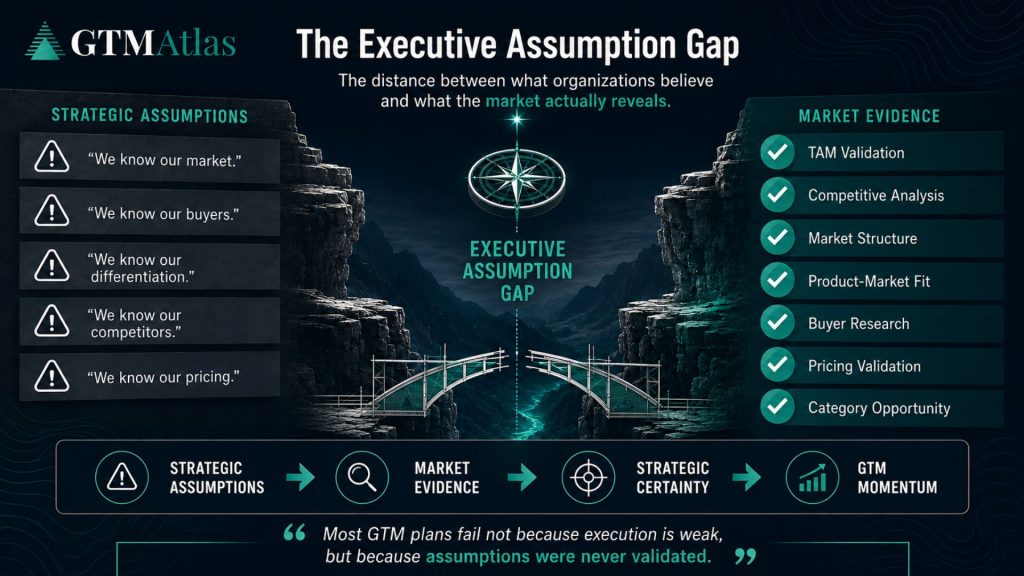
At GTMAtlas, we refer to this disconnect as the Executive Assumption Gap—the distance between what leadership believes about the market and what the market itself reveals. The wider the gap becomes, the more difficult execution becomes. Teams may appear aligned internally while unknowingly moving in the wrong direction externally.
This is why many organizations experience frustration during execution. The issue is not a lack of effort. It is that the strategy guiding that effort was never fully grounded in evidence.
When Strategy Is Built on Assumptions
The consequences of unvalidated assumptions are often invisible at the beginning of a GTM journey.
A company assumes its addressable market is large enough to support aggressive growth targets. Product leaders believe product-market fit has already been achieved. Sales teams assume buyers prioritize the same messages highlighted in marketing campaigns. Executives believe their solution is differentiated in ways that customers actually value. Pricing models are developed around internal opinions rather than proven willingness to pay.
None of these assumptions is necessarily wrong. Rather, the risk lies in treating them as facts before they have been validated.
Every downstream GTM decision, from positioning and segmentation to demand generation, pricing, sales motions, and resource allocation, depends on the accuracy of these foundational beliefs. Consequently, when those beliefs are not validated by market evidence, even highly capable teams can struggle to execute effectively.
The Evidence Missing From Many GTM Strategies
Before organizations decide how to win, they must first understand where they are playing and what conditions define the market.
Yet these foundational questions often remain unanswered.
1. How Large Is the Opportunity?
Many organizations estimate growth potential without fully understanding:
- Total Addressable Market (TAM)
- Serviceable Addressable Market (SAM)
- Serviceable Obtainable Market (SOM)
Without realistic market sizing, revenue expectations quickly become disconnected from market reality.
2. Are We Entering a Red Ocean or Creating a Blue Ocean?
Not every market requires the same GTM motion.
Some categories are mature, crowded, and highly competitive.
Others are emerging and require category education before demand creation.
Understanding the difference influences:
- Positioning
- Messaging
- Demand generation
- Sales motions
- Investment priorities
The wrong GTM strategy applied to the wrong market structure creates friction from day one.
3. Who Owns the Market Narrative?
Most competitive analyses focus on products.
Buyers rarely do.
Buyers respond to narratives.
The most influential companies do more than sell products.
They shape how markets think.
Organizations should ask:
- Who owns Mindshare?
- What and who is defining category language?
- Who is influencing buying criteria?
- Where do positioning gaps exist?
Market leadership often begins long before revenue leadership.
4. What Is Our Strategic Position?
Not every company occupies the same position within a market.
You may be:
- A category creator
- A challenger brand
- An early incumbent
- A disruptor
- A niche specialist
Each position requires a different GTM strategy.
Yet many organizations attempt to execute the playbook of market leaders while operating as challengers.
The result is confusion, misalignment, and inefficient execution.
5. Do We Actually Have Product-Market Fit?
Perhaps the most dangerous assumption in growth planning is believing product-market fit already exists.
Product-market fit is not determined internally.
It is determined by customers.
Evidence includes:
- Retention
- Expansion
- Customer advocacy
- Referral behavior
- Repeat purchasing
Without product-market fit, scaling GTM efforts often accelerates inefficiency rather than growth.
6. What Are Customers Actually Willing to Pay?
Pricing is often viewed as a financial decision.
In reality, it is a market validation exercise.
Organizations frequently debate:
- Freemium versus paid
- Subscription versus consumption
- Tiered versus fixed pricing
The more important question is:
How does the market perceive value?
The gap between perceived value and pricing strategy frequently becomes a hidden obstacle to growth.
7. Who Really Participates in the Buying Decision?
Many GTM plans still rely on simplified buyer personas.
Modern buying decisions rarely involve a single decision-maker.
Today's buying groups often include:
- Executive sponsors
- Economic buyers
- Technical evaluators
- End users
- Procurement stakeholders
Understanding how these stakeholders influence decisions is critical to creating alignment across marketing, sales, and customer success.
Choosing Where to Play Before Deciding How to Win
One of the most common mistakes in growth planning is confusing opportunity with focus.
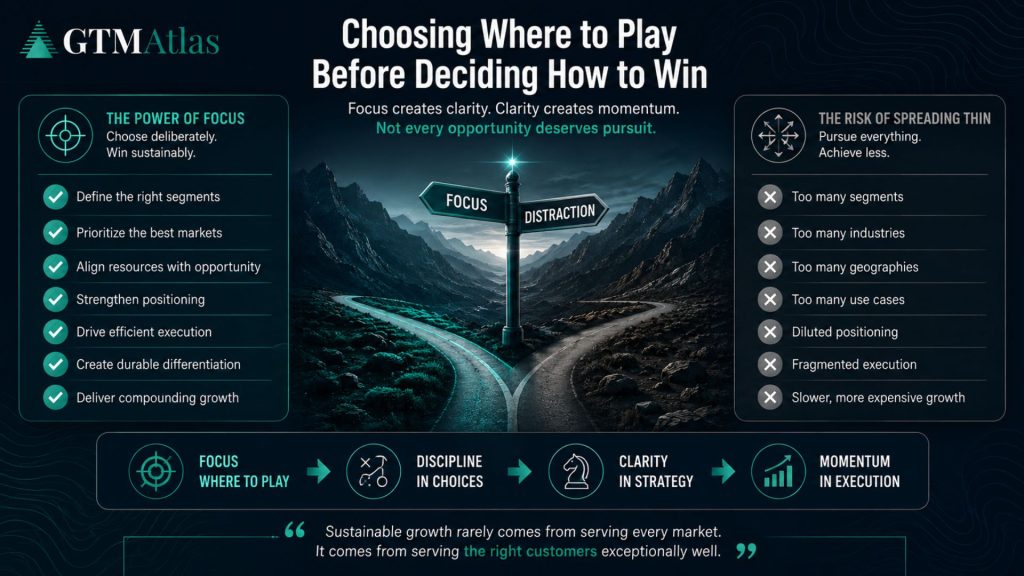
When organizations uncover multiple potential paths to growth, the instinct is often to pursue all of them simultaneously. New industries appear attractive. Additional customer segments seem reachable. Geographic expansion looks promising. New use cases emerge from customer conversations. While individually each opportunity appears logical. Collectively, they create complexity.
As priorities multiply, positioning becomes diluted. Messaging loses precision. Sales teams struggle to determine where to focus. Marketing resources become fragmented across competing initiatives. What began as an effort to maximize growth often results in reduced effectiveness across the board. Conversely, the strongest GTM organizations take a different approach. They recognize that strategic clarity is as much about what not to pursue as what to pursue. They understand that sustainable growth rarely comes from serving every possible market. It comes from making deliberate choices about where the organization can create the greatest value and the strongest competitive advantage.
Before deciding how to win, they first decide where to play.
That discipline creates focus. And focus creates momentum.
Why Strategic Certainty Creates GTM Momentum
When strategic decisions are grounded in evidence rather than assumptions, execution becomes dramatically more effective.
Marketing can align around a narrative that reflects how buyers actually think. Sales teams gain confidence in where to invest their time and resources. Product leaders can prioritize investments that reinforce market demand rather than internal preferences. Customer acquisition becomes more efficient because resources are concentrated in the areas most likely to produce results.
Most importantly, revenue growth becomes more predictable. Instead, the difference is not that these organizations work harder. The difference is that they operate with greater certainty.
Strategic certainty reduces friction across the entire GTM system. It allows teams to move faster because they are no longer debating foundational questions during execution. Alignment improves, decisions accelerate, and momentum becomes easier to sustain.
Organizations that establish clarity before execution create the conditions for long-term growth.
The GTMAtlas Point of View
At GTMAtlas, we believe that growth does not begin with campaigns, sales motions, technology investments, or quarterly execution plans.
Growth begins with understanding the market well enough to make confident strategic decisions.
Before organizations determine how they will execute, they must first establish where opportunity truly exists, which customers matter most, how buyers define value, what position they occupy within the market, and where sustainable differentiation can be created.
These questions are not tactical. They are foundational.
The organizations that answer them with evidence gain a significant advantage over those that rely primarily on assumptions. The strategies become more focused. The execution becomes more aligned. The investments become more intentional.
Most importantly, they create the conditions required for sustained GTM momentum.
Because the strongest go-to-market journeys are not built on assumptions.
They are built on evidence.
And evidence creates the strategic clarity required to keep the GTM journey in motion.
Next in The Atlas Series: The ICP Alignment Problem Nobody Talks About — When teams define the customer differently, GTM momentum suffers.