Key takeaways
- Organizations often face a "Momentum Gap," which is the critical, overlooked transition period between executive strategic approval and actual cross-functional execution, where growth initiatives quietly lose value.
- This loss of momentum is slow and invisible, driven by minor day-to-day operational delays across departments and a lack of clear ownership over the interconnected customer journey.
- To prevent stalling, companies must shift from managing isolated projects to treating go-to-market execution as a unified operating system that proactively reduces friction across all revenue teams.
Every leadership team knows the feeling
After months of planning, analysis, stakeholder discussions, and executive reviews, a go-to-market strategy is finally approved. The opportunity is clear. The priorities are aligned. Budgets have been committed. Teams leave the room energized by what comes next.
For a brief period, the organization feels unified. There is confidence in the direction, clarity around objectives, and a shared belief that growth is within reach.
Then something unexpected happens.
Not immediately. Not dramatically.
Gradually, momentum begins to fade.
Marketing waits for product readiness. Sales teams need enablement and messaging before they can confidently engage the market. Product teams continue balancing roadmap priorities and customer requests. Revenue Operations works to align systems, reporting, and measurement. Leadership teams receive new market signals that introduce fresh questions and competing priorities.
Everyone remains busy. Projects continue moving. Meetings fill calendars.
Yet progress feels slower than it should.
Weeks become months. Launch timelines shift. Dependencies multiply. Revenue targets become increasingly difficult to achieve. Eventually, leadership teams begin asking a familiar question:
“If everyone is working so hard, why does it feel like we’re moving so slowly?”
The answer reveals one of the most overlooked challenges in modern go-to-market execution.
Most organizations do not have a strategy problem.
They have a momentum problem.
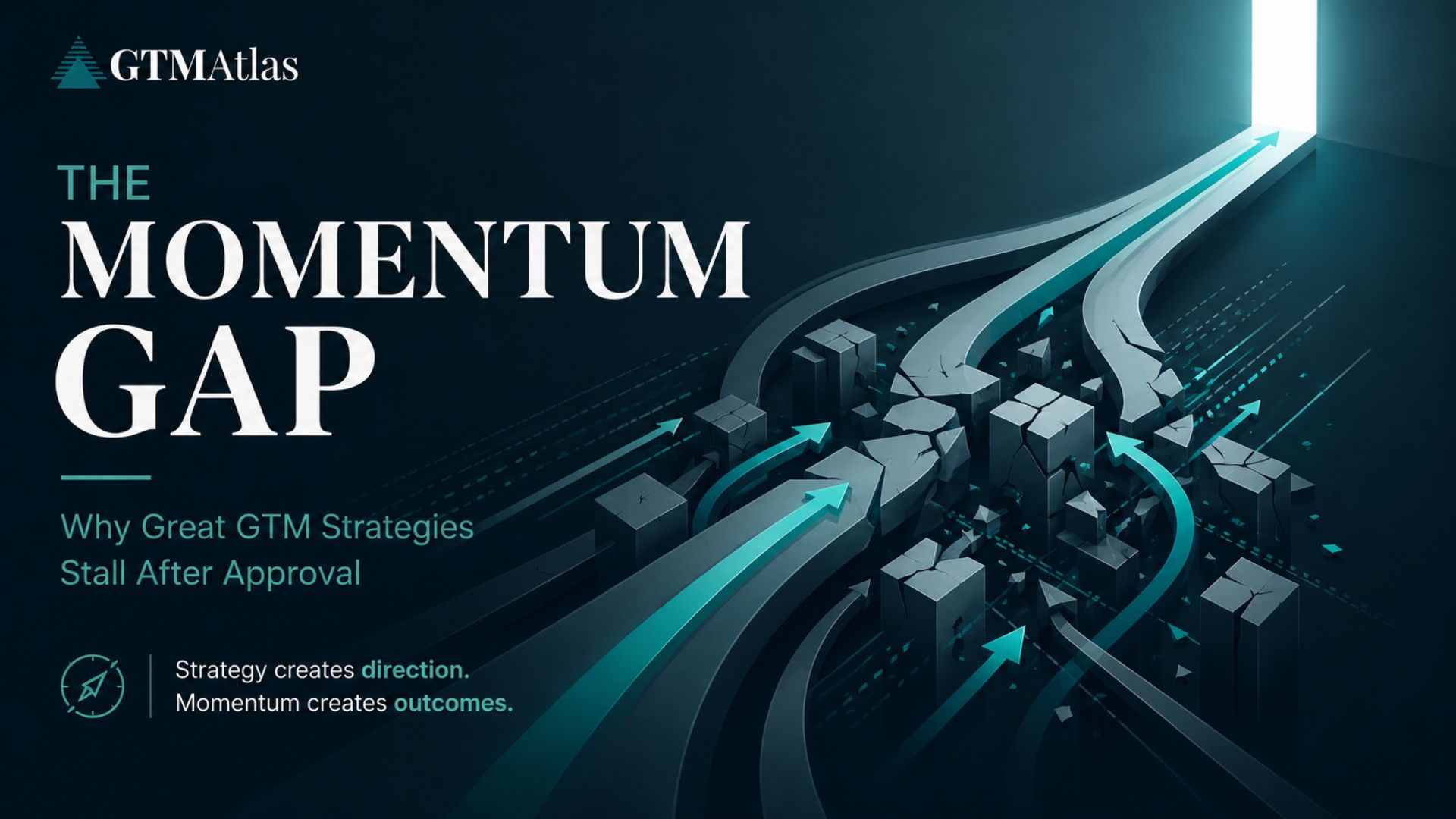
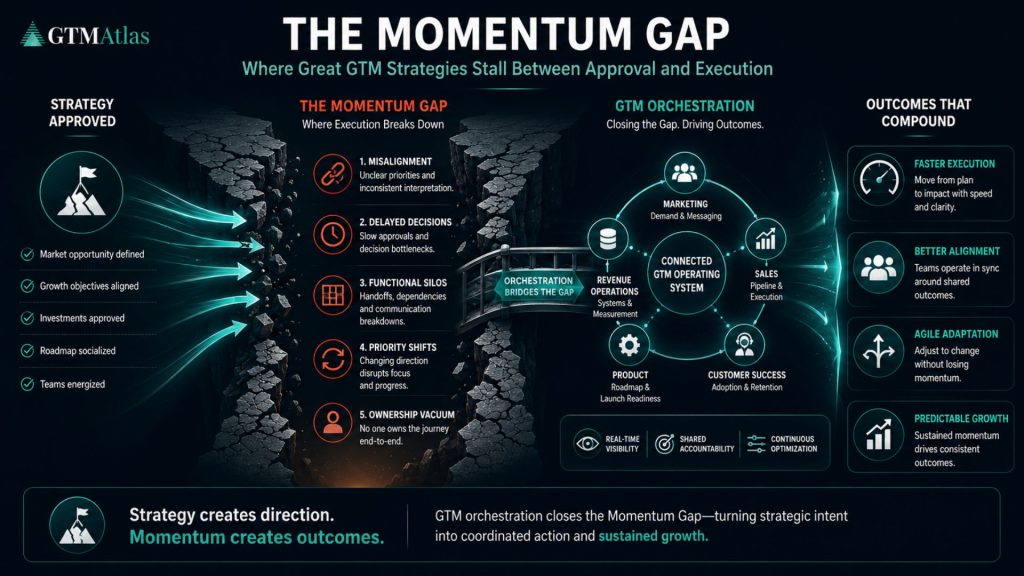
More specifically, they suffer from what we call the Momentum Gap: the distance between strategic approval and coordinated execution.
It is within this gap that growth initiatives slow down, alignment begins to fracture, and market opportunities quietly lose value before they ever reach customers.
The Hidden Cost of the Momentum Gap
When organizations evaluate growth challenges, the discussion typically focuses on one of two explanations. Either the strategy was flawed, or execution failed.
In reality, there is a third factor that often goes unnoticed.
Between strategy and execution sits a critical transition period where plans must be translated into action, ownership, accountability, workflows, systems, and cross-functional coordination. This is where momentum is either sustained or lost.
Unlike obvious failures, momentum loss rarely announces itself. It does not appear as a single missed milestone or a dramatic breakdown. Instead, it emerges through dozens of seemingly reasonable delays, decisions, and dependencies that gradually slow the organization’s ability to move.
A campaign launch waits for product updates. Sales enablement waits for finalized messaging. Reporting frameworks lag behind changing priorities. Cross-functional teams spend more time coordinating than executing. Each delay appears manageable. Collectively, they create friction that compounds throughout the business.
The market, meanwhile, does not wait.
Customers continue evaluating alternatives. Competitors continue launching initiatives. Buyer expectations continue evolving. By the time organizations resolve internal bottlenecks, the opportunity they were pursuing may have already shifted.
This is why momentum is no longer simply an execution challenge. It has become a strategic growth capability.
Why Momentum Has Become a Competitive Advantage
For decades, organizations could often compensate for slow execution. Markets moved more predictably. Competitive cycles were longer. Customer expectations evolved at a pace that allowed businesses time to recover from internal inefficiencies.
That environment no longer exists.
Today’s buyers are better informed, more selective, and less patient. Competitive advantages emerge and disappear faster than most organizations can comfortably adapt. New technologies continuously reshape customer expectations, while economic and market conditions can alter priorities almost overnight.
As a result, organizations increasingly compete on more than strategy alone.
They compete on their ability to align teams quickly, make decisions efficiently, and execute consistently despite complexity.
The companies gaining market share today are not always the ones with the most innovative ideas. More often, they are the organizations capable of translating strategic intent into coordinated action faster than their competitors.
They reduce friction between functions. They adapt without losing direction. They sustain execution velocity while others become trapped in cycles of coordination and rework.
In a market defined by speed and change, momentum has become a competitive advantage in its own right.
Where Momentum Quietly Breaks Down
The Momentum Gap rarely emerges from a single failure. More often, it is the result of systemic friction that accumulates throughout the organization.
One of the most common breakdowns occurs when strategic clarity fails to translate into operational clarity. Leadership teams may have complete alignment around what needs to happen, but execution teams often lack the same level of clarity regarding ownership, sequencing, dependencies, measurement, and decision-making authority. In the absence of clear operating structures, teams naturally fill gaps with assumptions. Those assumptions create misalignment, and misalignment slows momentum.
Cross-functional coordination presents another challenge. Modern go-to-market execution requires continuous collaboration between Marketing, Sales, Product, Customer Success, and Revenue Operations. Each function brings legitimate priorities and responsibilities. Yet many organizations approach alignment as a series of meetings rather than a coordinated operating motion. As teams work toward consensus, opportunities continue moving forward without them.
Leadership-driven course corrections create a third source of friction. New customer requirements emerge. Competitors introduce unexpected offerings. Market conditions shift. Adaptability is essential, but when every change forces teams to stop, regroup, and restart, organizations begin sacrificing continuity for responsiveness. Execution becomes episodic rather than sustained.
Perhaps the most significant challenge, however, is ownership. Most organizations assign responsibility to functions rather than journeys. Marketing owns campaigns. Sales owns the pipeline. The product owns the roadmap. Customer Success owns adoption. Revenue Operations owns systems and reporting. Yet few organizations designate ownership for the journey that connects them all. As initiatives move from one team to another, friction accumulates at every handoff. Progress slows not because people lack capability, but because orchestration is missing.
Also read: The ICP Alignment Problem: When Teams Define the Customer Differently, GTM Momentum Suffers
The Shift From Planning to Orchestration
Many organizations continue approaching go-to-market execution as a sequence of projects.
A strategy project is followed by a launch project. The launch project leads to enablement initiatives. Measurement and optimization come later. Each activity is managed independently, often by different teams operating with different priorities.
The problem is that growth does not occur through isolated projects.
Growth occurs through connected systems.
Organizations that consistently outperform their peers understand that go-to-market is not merely a collection of activities. It is an operating model. They focus on creating alignment across the entire revenue organization, ensuring that strategy, execution, measurement, and optimization operate as a unified motion rather than disconnected initiatives.
This shift fundamentally changes how momentum is maintained. Instead of relying on periodic alignment exercises, organizations create continuous visibility. Instead of managing handoffs, they manage outcomes. Instead of reacting to friction, they design operating models that reduce friction before it appears.
The result is not simply faster execution.
It is a more predictable execution.
Keeping the GTM Journey Moving
At GTMAtlas, we believe the greatest threat to growth is rarely the absence of strategy.
Most organizations already know where they want to go.
The greater challenge is maintaining momentum long enough to get there.
That requires more than planning. It requires orchestration. It requires connecting strategy, execution, measurement, and optimization into a unified go-to-market operating model that aligns Sales, Marketing, Product, Customer Success, and Revenue Operations around shared outcomes.
When organizations achieve this alignment, momentum becomes sustainable rather than situational. Teams move faster because priorities are clear. Decisions happen more efficiently because ownership is understood. Adaptation becomes easier because visibility exists across the entire journey.
The objective is not simply to launch initiatives.
The objective is to keep them moving.
The Path Forward
Every organization encounters friction. The difference between those who struggle and those who grow is not the presence of complexity. It is their ability to maintain momentum despite it.
The organizations that will outperform in the years ahead will not simply be the ones with better strategies. They will be the organizations that maintain alignment as complexity increases, sustain execution velocity as priorities evolve, and convert strategic intent into coordinated action more consistently than their competitors.
Because growth does not happen when strategy is approved, growth happens when momentum is sustained.
Strategy begins the journey. Momentum determines whether the journey continues.
Next in The Atlas Series: Strategic Foundations — Why Most GTM Plans Are Built on Strategic Assumptions Instead of Market Evidence.