
Key Takeaways
- Introduces The GTMAtlas Market Selection Hierarchy™, a framework for aligning market selection, customer definition, decision dynamics, value realization, and execution.
- Introduces Decision Signals, a GTMAtlas concept focused on understanding how buying committees prioritize, allocate budgets, and make purchasing decisions.
- Explores why many GTM execution challenges originate from market selection decisions made too late—or not made at all.
- Examines how market selection differs across startups, SMBs, and enterprise organizations.
- Provides a framework for identifying the markets where sustainable GTM momentum can be created and maintained.
In Part 1 of this series, we introduced the GTM Momentum Gap™ and explored why many growth initiatives lose momentum after strategy approval. Then in Part 2, we discussed the importance of strategic clarity and the role it plays in aligning organizations around a common direction. In Part 3, we examined how inconsistent interpretations of the Ideal Customer Profile create friction across Sales, Marketing, Product, Customer Success, and Revenue Operations.
Together, these challenges reveal an important reality. Sustainable growth requires more than strategy, alignment, and execution. It requires conviction about the market an organization intends to win. Yet many organizations begin scaling GTM motions long before this decision has been fully validated.
As a result, leadership teams often find themselves confronting symptoms that appear operational but are fundamentally strategic in nature. Pipeline quality deteriorates despite increased investment. Average contract values remain below expectations. Customer acquisition costs rise. Sales cycles lengthen. Teams become increasingly productive while revenue outcomes become increasingly unpredictable.
In our experience, these challenges frequently originate from a common source: organizations begin optimizing how they intend to win before establishing where they intend to play.
The Market Selection Trap
Market selection is often treated as a segmentation exercise. Organizations evaluate market size, identify industries, build account lists, and define target personas. While these activities are necessary, they frequently create the illusion of market clarity without establishing strategic commitment.
The more important question is not whether a market exists. The more important question is whether that market possesses the economic, operational, and organizational conditions necessary to support sustainable growth.
This distinction becomes increasingly important as organizations scale. Market selection decisions influence pricing strategy, customer acquisition economics, sales motions, onboarding models, resource allocation, and long-term profitability. When market selection is unclear, every downstream GTM decision becomes more difficult.
Over the years, we have observed organizations investing heavily in execution while simultaneously struggling to answer a fundamental question: Which market are we actually trying to win?
From a GTMAtlas perspective, many GTM execution challenges are market selection challenges in disguise.
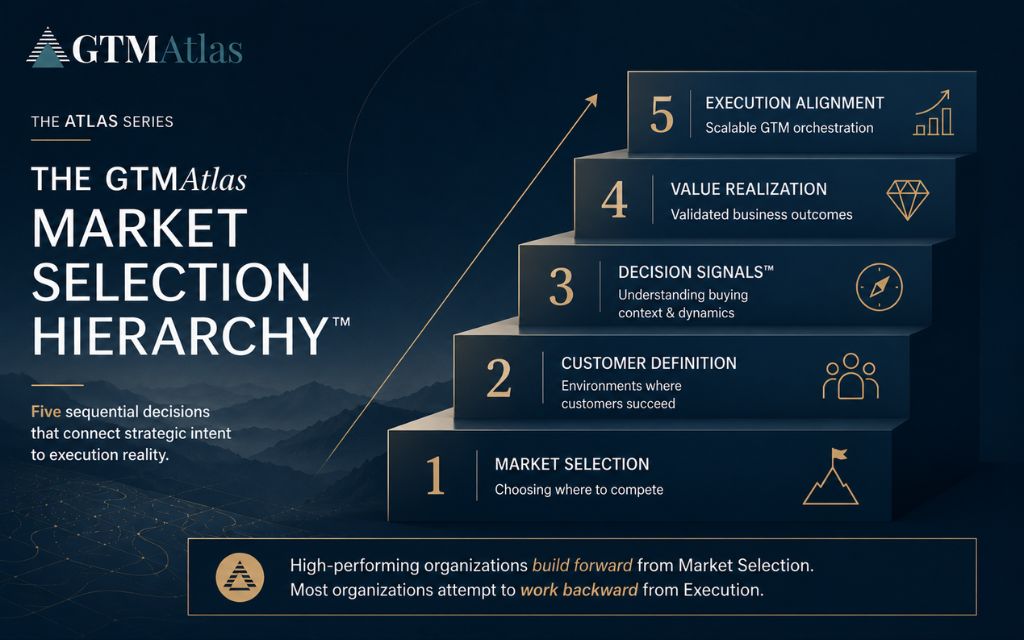
The GTMAtlas Market Selection Hierarchy™
To address this challenge, we developed the GTMAtlas Market Selection Hierarchy™, a framework designed to help organizations align strategic intent with execution reality.
The framework consists of five sequential decisions.
The first decision is determining where the organization intends to play. This involves evaluating market attractiveness, category dynamics, competitive intensity, customer economics, and long-term growth potential.
The second decision is defining who the organization intends to serve. This extends beyond traditional ICP development and requires a shared understanding of the environments, buying contexts, and business conditions in which customers are most likely to succeed with the solution.
The third decision focuses on understanding how customers make decisions. This is where many GTM frameworks stop short.
The fourth decision centers on value realization. Organizations must understand why customers will choose them over available alternatives and how that value will be communicated, validated, and measured.
The fifth decision involves determining how to operationalize and scale the GTM motion across Sales, Marketing, RevOps, Product, and Customer Success.
Organizations frequently begin with the fifth decision and work backward. High-performing organizations tend to begin with the first and build forward.
Beyond Buying Signals: The Importance of Decision Signals
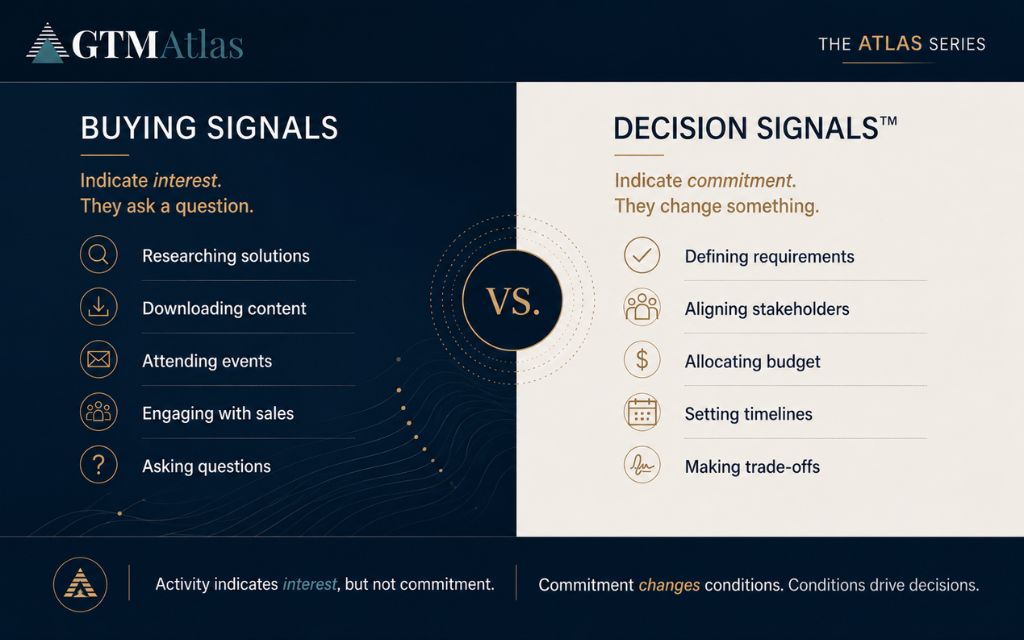
One of the most important observations from enterprise GTM environments is that buying activity and buying decisions are not the same thing.
Modern GTM teams have become increasingly sophisticated at capturing buying signals. Intent data, engagement metrics, content consumption patterns, website activity, event participation, and product interactions provide valuable insight into customer interest. However, these indicators rarely explain how purchasing decisions are ultimately made.
Throughout our experience supporting complex GTM motions, we have repeatedly observed opportunities that appeared healthy by every conventional measurement. Stakeholders were engaged. Meetings were progressing. Technical evaluations were successful. Executive discussions were constructive. Pipeline forecasts reflected confidence.
Yet the deals failed to materialize.
In many cases, the underlying issue had little to do with product capabilities, pricing, or competitive positioning. Strategic priorities shifted. Budget ownership changed. Executive sponsors lost influence. Transformation initiatives were delayed. Internal consensus broke down.
These dynamics are not buying signals.
They are decision signals.
At GTMAtlas, we define decision signals as indicators that reveal how organizations prioritize initiatives, allocate resources, build stakeholder consensus, and ultimately commit to investment decisions. Understanding these signals provides a more accurate view of opportunity health than engagement metrics alone, particularly within enterprise buying environments.
Organizations that learn to identify decision signals gain a significant advantage. They understand not only whether customers are interested, but whether customers are progressing toward a decision.
Why Market Selection Looks Different Across Growth Stages
A common misconception within GTM planning is that the same growth model can be applied across different stages of organizational maturity. In reality, startups, SMBs, and enterprises face fundamentally different market selection challenges.
For startups, market selection is often a question of identifying economic gravity. Many early-stage companies successfully build products and generate customer interest, yet struggle to establish sustainable growth because the underlying market lacks sufficient urgency, scale, or profitability. In these environments, execution quality is rarely the limiting factor. More often, the challenge lies in finding a market where customer demand, pricing potential, and operational economics align.
For SMBs, market selection becomes an exercise in repeatability. The challenge is not simply generating revenue but creating systems that consistently reproduce successful outcomes. Growth requires identifying customer segments where acquisition, onboarding, expansion, and retention can be standardized and scaled efficiently.
Enterprise organizations face a different challenge altogether. Complexity becomes the dominant variable. Buying decisions involve multiple stakeholders, competing priorities, geographic considerations, governance requirements, and extensive consensus-building processes. Market selection, therefore, depends not only on identifying opportunities but also on understanding the decision environments that influence purchasing behavior.
In each case, the market selection process must align with the realities of the organization’s growth stage and operating model.
The Difference Between Market Opportunity and Market Commitment
Some of the most instructive GTM experiences emerge when organizations attempt to enter new markets.
In certain cases, organizations pursue markets with strong technological capabilities but limited economic viability. In others, companies attempt to reposition themselves into higher-value customer segments despite existing market perceptions that suggest otherwise. Conversely, organizations that achieve sustained momentum often demonstrate remarkable discipline in aligning acquisitions, product investments, sales motions, marketing programs, and operational processes around a clearly defined market objective.
These outcomes reinforce an important distinction.
Market opportunity and market commitment are not the same thing.
Many organizations identify attractive opportunities.
Far fewer make the organizational commitments required to win them.
The difference often determines whether GTM momentum accelerates or stalls.

Final Thoughts
Many organizations assume growth challenges originate within execution. Consequently, they focus on optimizing campaigns, expanding teams, introducing new technologies, or refining operational processes.
While these initiatives are valuable, they often address symptoms rather than causes.
The more strategic question is whether the organization has established clear alignment around the market it intends to win. Without that alignment, even the most sophisticated GTM motions can struggle to generate sustainable outcomes.
At GTMAtlas, we believe sustainable GTM momentum begins with market commitment. Before organizations decide how to win, they must determine where to play, who to serve, how decisions are made, why customers will choose them, and how those insights will be operationalized across the business.
Only then can execution become predictable.
Only then can alignment become durable.
And only then can GTM momentum remain in motion.
Next in The Atlas Series: Part 5 — From Strategy to Execution: Building the GTM Operating System That Keeps Growth Moving