Reflections from My Guest Lecture at Santa Clara University
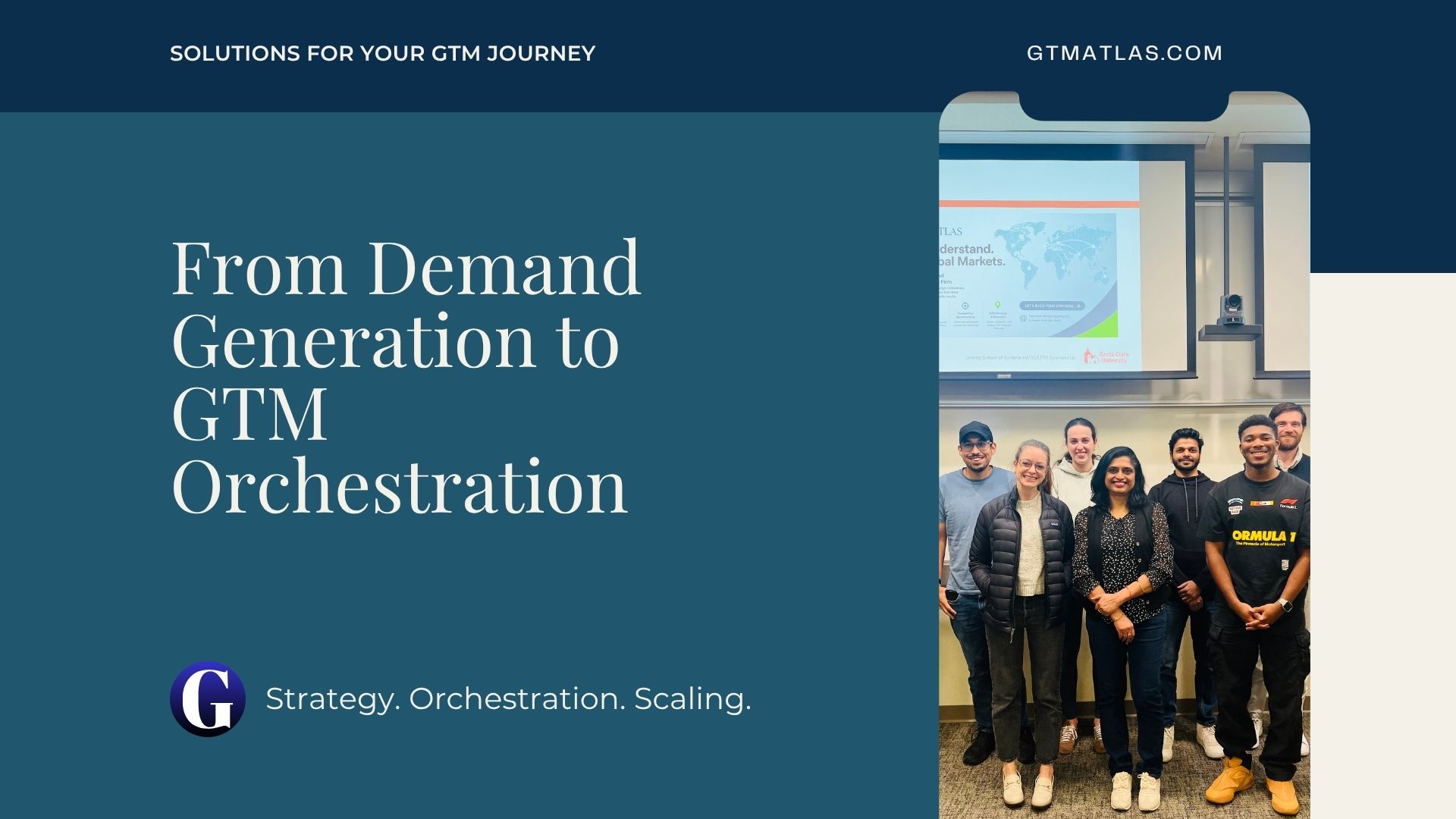
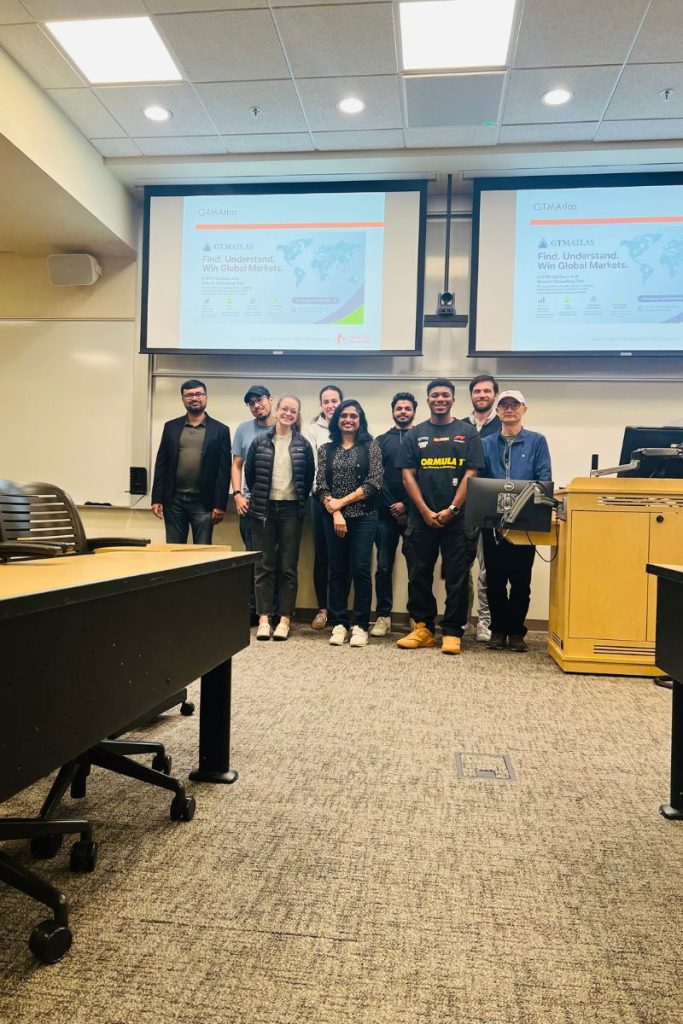
Recently, I had the opportunity to speak with MBA graduate students at Santa Clara University as part of Professor Desmond Lo’s Go-to-Market Strategy course.
The session focused on a topic that is becoming increasingly important for modern enterprises: how Demand Generation has evolved from a campaign-driven marketing function into a coordinated Go-to-Market operating system.
As Chief Growth Officer at GTMAtlas, I wanted the discussion to move beyond tactical marketing conversations and instead help students think like future GTM leaders. The objective was not simply to explain channels, funnels, or lead generation mechanics. It was to unpack how modern organizations create scalable, measurable, and efficient revenue growth in an increasingly complex buying environment.
What made the experience particularly rewarding was the quality of engagement from the students. The audience included aspiring marketers, AI strategy consultants, engineers, operators, and future business leaders, many of whom were interested in understanding how modern enterprise GTM organizations operate behind the scenes.
The reality is that the GTM landscape has fundamentally changed.
Modern buyers are more informed. Buying committees are larger. Sales cycles are longer. AI is accelerating execution velocity. And revenue organizations are now expected to operate with far greater precision, accountability, and alignment than ever before.
That shift formed the foundation of our discussion throughout the lecture.
Demand Generation Is No Longer About Lead Volume
One of the central themes from the session was an important distinction that many organizations still struggle to internalize:
If lead generation is collecting names, demand generation is creating market preference.
Historically, many companies approached demand generation as a volume exercise. The focus was often on maximizing lead counts, driving campaign activity, or optimizing short-term acquisition metrics.
But modern B2B growth no longer operates that way.
Today’s buyers spend significant time educating themselves before engaging with sales organizations. They consume analyst research, peer reviews, webinars, executive thought leadership, customer case studies, social proof, and digital content across multiple channels before entering formal buying conversations.
This means that demand generation is no longer simply a marketing activity. It has become a strategic revenue function that influences how organizations position themselves in the market, engage buying groups, orchestrate customer journeys, and ultimately accelerate revenue creation.
During the lecture, we discussed how modern GTM organizations increasingly operate as integrated revenue systems rather than siloed functional departments.
That distinction is critical.
The organizations creating durable market leadership today are not necessarily those with the loudest campaigns or the largest technology stacks. They are the organizations that can align strategy, execution, intelligence, and operations more effectively than competitors.
GTM Strategy Begins with Market Intelligence and Strategic Clarity
Another major theme from the session focused on a misconception that still exists in many organizations.
Demand generation does not begin with campaigns. It begins with strategic clarity. That clarity comes from understanding the following:
- Total Addressable Market (TAM)
- Ideal Customer Profiles (ICPs)
- Buying groups and personas
- Customer pain points
- Market positioning
- Revenue objectives
This systems-driven approach is foundational to how GTMAtlas approaches GTM strategy and execution.
Our solutions combine:
- Market and ICP Intelligence
- Narrative and Positioning
- Integrated GTM Orchestration
- Revenue Execution
- Optimization and Scale
The objective is not simply activity generation. The objective is predictable and measurable revenue growth.
One of the most important ideas shared with the students was that great marketing organizations increasingly behave like revenue organizations. They think deeply about operating models, pipeline mechanics, conversion efficiency, customer economics, and cross-functional execution.
That mindset shift is redefining modern GTM leadership.
Why Account-Based Marketing (ABM) Has Become a Strategic Growth Discipline
A significant portion of the lecture focused on Account-Based Marketing (ABM) and its growing importance in enterprise GTM strategy.
ABM is often misunderstood as a tactical personalization exercise or a targeted advertising strategy. In practice, enterprise ABM is far more strategic and operationally sophisticated.
ABM is fundamentally about precision.
Account-Based Marketing (ABM) is about:
- Prioritizing the right accounts
- Understanding buying group behavior
- Coordinating multi-touch engagement
- Aligning sales and marketing execution
- Measuring account progression and pipeline impact
- Orchestrating engagement across the customer lifecycle
In enterprise environments such as cybersecurity, SaaS, fintech, and infrastructure technology, organizations are increasingly moving from volume-based lead models to precision GTM models.
Why are organizations moving to precision GTM models?
Because enterprise buying decisions now involve:
- Multiple stakeholders
- Longer sales cycles
- Greater procurement scrutiny
- More complex evaluation processes
ABM allows organizations to orchestrate engagement intentionally across the entire buying committee instead of relying on disconnected campaigns.
This directly aligns with GTMAtlas's core capabilities:
- Account and Buying Group Strategy
- Integrated Campaigns and GTM Orchestration
The organizations that execute ABM effectively are not simply running campaigns. They are building coordinated revenue systems designed around buying group engagement and pipeline progression.
GTM Orchestration Is Emerging as a Competitive Differentiator
One of the recurring themes throughout the session was this:
Most companies do not have a technology problem. They have an operational alignment problem. Modern GTM environments have become significantly more fragmented. Organizations are managing more channels, more tools, more data, more stakeholders, and more AI systems than ever before.
As a result, companies often struggle with:
- Misaligned messaging
- Funnel leakage
- Poor lead-to-account coordination
- Inconsistent buyer experiences
- Weak attribution
- Pipeline inefficiency
- Disconnected customer engagement
This is precisely why GTM orchestration is becoming one of the defining capabilities of high-performing revenue organizations.
High-performing GTM teams now align:
- Strategy
- Messaging
- Content
- SDR execution
- Paid media
- Sales engagement
- Revenue operations
- Analytics
- Customer expansion initiatives
The outcome is not simply better campaign performance.
The outcome is greater organizational efficiency, stronger pipeline predictability, improved conversion rates, and more scalable revenue growth.
AI Is Reshaping the GTM Operating Model
Another major focus of the session was the role AI is beginning to play across modern GTM organizations.
The discussion extended far beyond content generation tools and into operational transformation.
AI is now influencing:
- Audience targeting
- Intent analysis
- Predictive forecasting
- Campaign execution
- SDR workflows
- Conversation intelligence
- Pipeline analytics
- Personalization
- Revenue intelligence
One of the most important points discussed with the students was this:
The real power of AI is not content generation. It is decision acceleration.
AI is rapidly becoming a strategic execution layer across marketing, sales, RevOps, and customer engagement functions. At the same time, AI is also creating a new challenge: content commoditization. As AI-generated content becomes easier to produce, differentiation, positioning, and strategic clarity become even more important.
This is precisely why organizations need stronger GTM solutions, not just more technology.
The Future of GTM Belongs to Integrated Revenue Organizations
One of the most valuable discussions with the MBA students centered around the evolution of GTM careers.
The traditional boundaries between marketing, sales, operations, analytics, and customer success are rapidly disappearing.
Modern GTM leaders increasingly need fluency across:
- Revenue operations
- Data and analytics
- Buyer psychology
- Pipeline mechanics
- AI-enabled execution
- Cross-functional orchestration
The organizations that scale efficiently are the ones that can:
- Align faster
- Learn faster
- Execute faster
- Optimize continuously
This shift is exactly why GTMAtlas was built around connecting strategy, intelligence, orchestration, and execution into a unified GTM operating model.
Because modern GTM is no longer about isolated functions.
It is about coordinated revenue execution.
Appreciation That Made the Experience Meaningful
I’m deeply grateful to Professor Desmond Lo for the opportunity to contribute to the program and engage with such thoughtful students.
One message that particularly stood out to me afterward was:
“Demand generation is no longer just marketing campaigns. It’s now a coordinated revenue system.”
I was also incredibly encouraged by the feedback shared after the session.
Professor Lo wrote:
“As always, I am grateful for your contribution to my class and for educating our graduate students. They loved your guidance from last night!”
Elizabeth Mitelman shared:
“Really enjoyed your presentation today, thanks so much!”
And Naveen Shastri noted:
“I especially liked hearing about demand generation, revenue growth, and the education, solution, and selection framework.”
Those conversations reinforced something important:
The next generation of GTM leaders is already thinking beyond siloed marketing execution. They are thinking about orchestration, systems, intelligence, and scalable growth.
And that is exactly where modern GTM is heading.
Final Thoughts
The GTM landscape is evolving rapidly.
Demand generation is no longer an isolated campaign execution.
ABM is no longer optional in enterprise growth environments.
AI is no longer experimental.
And GTM alignment is no longer a secondary initiative.
The future belongs to organizations that can integrate:
- Market intelligence
- Narrative and positioning
- Buying group strategy
- Revenue execution
- AI-enabled decision-making
- Cross-functional orchestration
At GTMAtlas, that is the operating philosophy we continue to build around every day.
Because winning GTM organizations do not operate as disconnected teams.
They operate as unified revenue systems.