
GTM TEAM ALIGNMENT
Move GTM Forward. Together.
Eliminate silos. Unify your revenue engine. Drive predictable growth.
Aligning Your GTM Teams to Move as One Revenue System
Teams often operate from different strategies, priorities, timelines, and definitions of success. Without a shared operating rhythm, these differences can create fragmented GTM motions, disconnected decisions, and inconsistent execution across the revenue system.
GTMAtlas transforms this complexity into a dynamic, enterprise-grade operating model. We align teams around a shared strategy and unified execution cadence by:
Defining clear ownership across the entire funnel.
Establishing shared metrics to evaluate success.
Connecting the decisions that shape GTM execution.
The outcome: Faster execution, stronger accountability, and a GTM model that compounds impact.
When GTM Moves as One, Momentum Compounds.
ASSESS
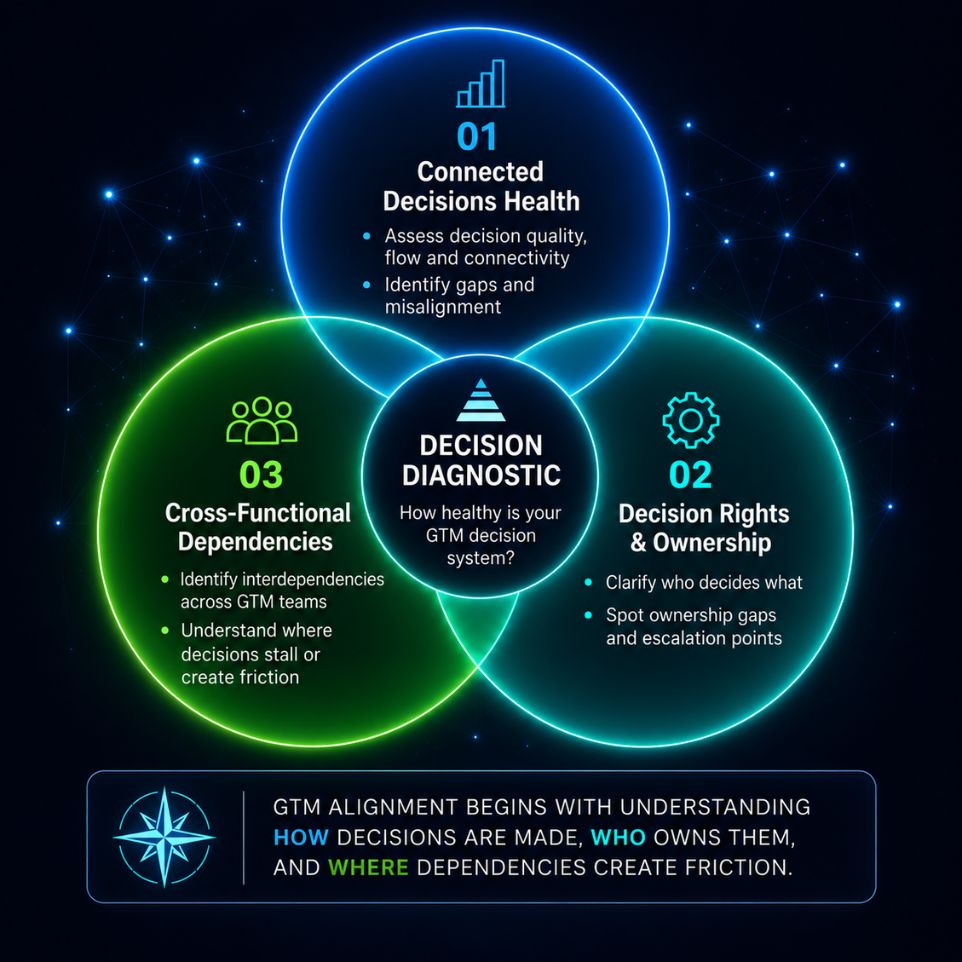
Diagnose GTM Decision Fragmentation
Find where the system is disconnected.
Connected Decisions Health Assess how effectively critical GTM decisions are connected across functions.
Decision Rights & Ownership Clarify who owns key decisions and where ambiguity or escalation slows progress.
Cross-Functional Dependencies Identify where teams depend on one another and where those dependencies create friction.
GTM alignment begins with understanding how decisions are made, who owns them, and where dependencies create friction.
ALIGN
Create Shared Strategic Context
Establish what matters and what matters most.
Once decision fragmentation is understood, the next step is to establish a shared strategic context across the GTM organization. We align teams around a common understanding of business priorities, market realities, customer needs, and the outcomes that matter most. From there, we make the critical choices and trade-offs explicit, translate them into shared GTM priorities, and create the accountability needed to move forward together.
Shared Context
Create a common understanding of the business, market, customer, and GTM realities.
Strategic Priorities
Define the few priorities that matter most to the business.
Clear Choices
Make explicit the choices and trade-offs that guide GTM decisions.
Shared Commitment
Translate priorities and choices into shared GTM objectives and accountability.
Alignment begins when teams share the same context, understand what matters most, and commit to the choices that move the business forward.
CONNECT
Connect Interdependent Decisions
Connect the decisions that must work together.
Once teams share the same context and strategic priorities, the next step is to connect the decisions that shape GTM execution. GTMAtlas maps the relationships between cross-functional decisions, clarifies decision rights, and identifies the dependencies that must move together. This creates a connected decision system where teams can make faster, more coherent choices without losing functional accountability.
Connect Priorities
Translate shared strategic priorities into coordinated cross-functional decisions.
Connect Decision Rights
Clarify who decides, who contributes, and where decisions intersect.
Connect Dependencies
Align the interdependencies that must move together for GTM execution to progress.
Connected Decisions. Coordinated Action. Shared Outcomes.
SYNCHRONIZE
Build the Operating Rhythm
Turn connected decisions into coordinated execution.
GTMAtlas designs and implements a unified GTM operating rhythm to keep your revenue organization aligned in execution. We establish the planning cadences, decision forums, governance mechanisms, and feedback loops required to translate connected decisions into coordinated action, surface performance gaps, and continuously improve the way your GTM system operates.
1
Shared Planning & Priorities
One GTM Plan
2
Decision Rights & Ownership
Clear Decision Ownership
3
Operating Cadence & Governance
One Operating Rhythm
4
Execution Orchestration
Coordinated Execution
5
Feedback Loops & Learning
Continuous Learning
OPTIMIZE
Create the Closed-Loop System
Learn, adapt, and continuously improve.
GTMAtlas builds a GTM system where better decisions create better execution, better outcomes, and progressively stronger performance over time.
Measure Outcomes
Track the business outcomes that matter, not just functional activity
Surface Signals
Turn data and performance signals into actionable intelligence
Adapt Decisons
Use what the system learns to improve strategic and operational choices
Compound Learning
Make learning part of how the GTM system operates
CONTINUE
What's Next?
Next Step: Orchestrate the GTM motion around it.
You’ve aligned your GTM teams around shared priorities, connected decisions, and coordinated execution. Now translate that alignment into market momentum through integrated campaigns and orchestrated GTM motions. Bring strategy, messaging, channels, and execution together so every element works in concert to create a frictionless path from strategic intent to market impact.
01
GTM Strategy & Market Architecture
02
Account and Buying Group Strategy (ABM)
03
GTM Team Alignment
04
Integrated Campaigns & GTM Orchestration
05
Revenue Enablement & Conversion
06
GTM Intelligence & Optimization
One Journey. Six Capabilities. Continuous Momentum.
Frequently Asked Questions
UNDERSTANDING THE ARCHITECTURE
What is GTM Team Alignment?
GTM Team Alignment creates the organizational conditions for Marketing, Sales, RevOps, Customer Success, Product, and Finance to operate as one connected revenue system. It goes beyond functional alignment to connect the decisions, priorities, dependencies, and outcomes that shape the customer and revenue journey.
GTMAtlas aligns teams around shared strategic context, clarifies decision ownership, connects interdependent decisions, and establishes the operating rhythm required to turn strategy into coordinated execution and predictable growth.
Why is GTM Team Alignment about more than Sales and Marketing alignment?
Sales and Marketing alignment is important, but complex GTM decisions rarely stop at those two functions. Product shapes market relevance, Customer Success influences retention and expansion, RevOps provides operational intelligence, and Finance shapes investment and resource allocation.
GTMAtlas takes an enterprise view by connecting the decisions that are interdependent across the GTM organization. The objective is not to make every function work the same way. It is to ensure the decisions that must work together are connected.
What is the GTMAtlas Connected Decisions Framework™?
The GTMAtlas Connected Decisions Framework™ is an enterprise framework for connecting the decisions that shape GTM performance. It is built around four principles: Shared Context, Clear Choices, Coordinated Teams, and Shared Outcomes.
The framework brings together six organizational decision nodes — Marketing, Sales, RevOps, Customer Success, Product, and Finance — within one GTM system. The result is a more connected decision environment where functional accountability remains intact while critical cross-functional decisions move together.
How does the Connected Decisions Framework™ connect different GTM functions?
The framework treats Marketing, Sales, RevOps, Customer Success, Product, and Finance as organizational decision nodes, not isolated functional pillars. We identify where decisions intersect, clarify decision rights, and map the dependencies that require coordinated action.
This creates a connected decision system without forcing every function into every decision. Teams retain functional ownership while working from shared priorities, coordinated dependencies, and common business outcomes.
What does it mean to connect decisions by dependency rather than by hierarchy?
Organizations do not need every team to make the same decisions. They need the decisions that are interdependent to be connected. GTMAtlas maps those dependencies to determine where decisions must inform, enable, or move together across functions.
This shifts alignment from an organizational-chart exercise to a decision-architecture exercise. The result is greater clarity around who decides, who contributes, where decisions intersect, and what must happen next for GTM execution to move forward.
PUTTING THE MODEL INTO MOTION
What inputs do you need from our organization to assess GTM alignment?
We work with GTM and executive leadership to bring together the inputs needed to understand how the organization makes and executes critical decisions. These typically include strategic priorities, GTM plans, organizational responsibilities, decision rights, shared objectives and OKRs, operating cadences, cross-functional dependencies, and relevant performance data.
We also engage the leaders and teams responsible for translating strategy into execution. This provides a practical view of where decisions are connected, where they become fragmented, and where organizational friction is slowing GTM momentum.
How does GTMAtlas identify decision fragmentation across the GTM organization?
We assess how critical GTM decisions move across functions, who owns them, where dependencies exist, and where ambiguity or competing priorities create friction. The assessment looks beyond organizational structure to understand how decisions actually move from strategy to execution.
Our Connected Decisions Health approach examines decision rights, cross-functional dependencies, priority alignment, operating cadence, execution translation, feedback loops, and outcome alignment. The objective is to identify where the GTM system is disconnected and where better-connected decisions can improve performance.
How long does a GTM Team Alignment engagement take?
A typical diagnostic and strategic alignment phase takes approximately 6 to 8 weeks, followed by operating-model integration and implementation as needed. The exact timeline depends on organizational complexity, the number of functions involved, data availability, leadership alignment, and the scope of the engagement.
GTMAtlas can engage at different levels, from diagnosing decision fragmentation and establishing shared priorities to designing the operating rhythm and mechanisms required to sustain connected execution.
How do you measure the impact of GTM Team Alignment?
We measure success through a combination of organizational health, execution performance, and business outcomes. This can include decision velocity, clarity of ownership, cross-functional friction, priority alignment, operating cadence, execution consistency, and the effectiveness of feedback loops.
We then connect those improvements to the business outcomes that matter: growth, win rates, pipeline quality, retention, expansion, profitability, scale, and efficiency. The objective is not alignment for its own sake. It is creating a GTM system where better-connected decisions produce better business outcomes.
How does GTM Team Alignment connect with the other GTMAtlas capabilities?
GTM Team Alignment builds on the strategic foundation established through GTM Strategy & Market Architecture and connects directly with Account & Buying Group Strategy. It creates the organizational alignment required to translate market choices and account strategies into coordinated execution.
From there, the Connected Decisions model provides a foundation for the broader GTM system, connecting campaigns, enablement, intelligence, and optimization around shared priorities and outcomes. This creates a continuous GTM journey from strategy to orchestration to scaling.