Executive Takeaways
- The Atlas Series presents a connected framework for modern GTM transformation. It is not a collection of standalone articles. Each executive perspective builds upon the previous one, creating a broader framework for how organizations maintain momentum from strategic clarity to enterprise value creation.
- The GTM Operating Model must evolve from coordinating functions to governing enterprise decisions.
- Enterprise Value becomes the ultimate growth outcome.
- The Intelligent Enterprise is the next frontier of GTM transformation.
- Business outcomes, not activity metrics, become the measure of GTM success.
- Finance becomes an active participant in growth decisions.
Revenue Growth Requires a Connected GTM Operating Model
Modern organizations are not suffering from a shortage of strategy, technology, data, or talent. Yet many continue to struggle with a challenge that has become increasingly difficult to solve: maintaining predictable growth in an environment defined by constant change.
Markets move faster than they once did, and competitive landscapes shift unexpectedly. Moreover, investors influence strategic priorities while analysts reshape market perceptions. Technology continues to alter buyer expectations. Artificial intelligence accelerates the pace at which information is created, distributed, and consumed. At the same time, buying committees are becoming larger, decision-making processes are becoming more complex, and customer journeys are less predictable.
Against this backdrop, organizations continue investing heavily in growth initiatives. For instance, they introduce new technologies, launch new campaigns, expand teams, and refine operating processes. Yet many still experience the same outcome. Momentum slows. Forecasts become less reliable. Execution becomes fragmented. Growth becomes harder to sustain.
At GTMAtlas, we launched The Atlas Series to explore how organizations can navigate modern market complexity while keeping their GTM journey in motion. Throughout this series, one theme has consistently emerged: sustainable growth requires more than strategy. It requires a connected operating model capable of translating strategic clarity into coordinated market execution.
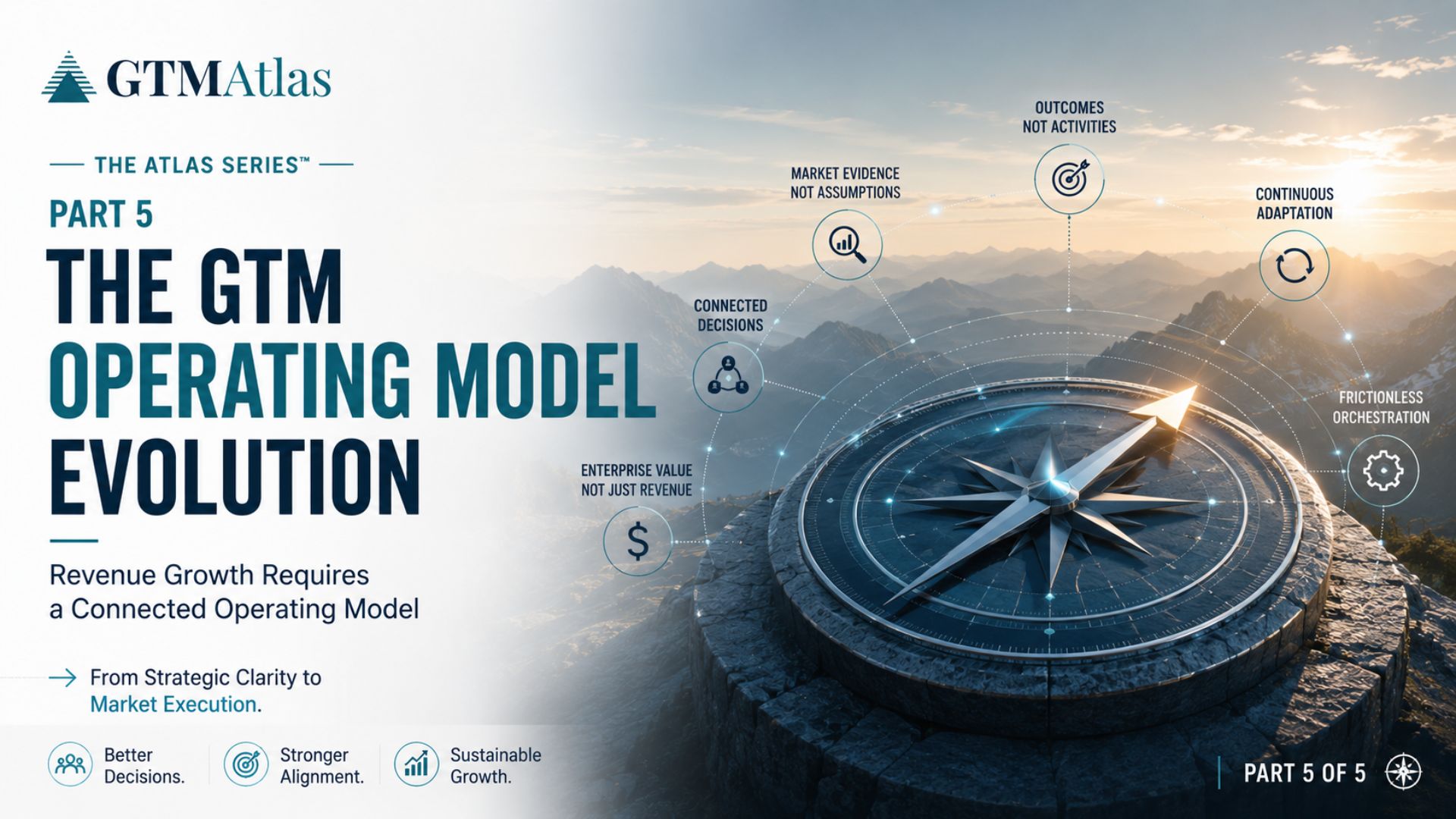
Every executive perspective in The Atlas Series explores a distinct source of GTM friction. Together, they form a connected framework that progresses from strategic clarity to enterprise value creation. The visual below provides a high-level view before we examine the foundations of a connected GTM Operating Model.
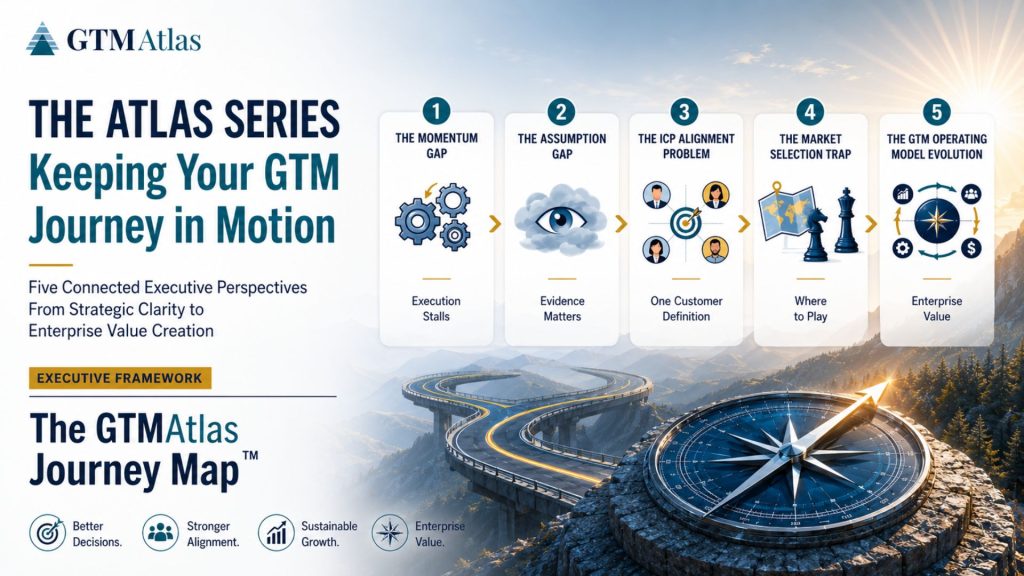
The future of GTM will not be defined by individual functions operating more efficiently. It will be defined by how effectively organizations orchestrate decisions, resources, and execution around business outcomes.
Foundations of a Connected GTM Operating Model
A modern GTM Operating Model relies on four foundational capabilities that help reduce operational friction, improve alignment, and maintain organizational momentum.
Unified Data and Shared Visibility
A connected operating model begins with a common operating picture. Marketing, Sales, Customer Success, Product, Revenue Operations, and Finance must have access to consistent customer, market, and performance data. Shared visibility reduces conflicting interpretations and improves decision quality across the organization.
Intelligent Process Orchestration
As customer journeys become more complex, organizations must reduce reliance on manual coordination. Intelligent orchestration connects workflows, accelerates response times, and ensures critical opportunities move efficiently across the customer lifecycle.
Cross-Functional Governance
Alignment requires more than collaboration. It requires clear accountability, shared objectives, decision rights, and operating rhythms that enable teams to move together toward common goals.
Continuous Measurement and Learning
Organizations must continuously evaluate performance, identify emerging risks, and adapt to changing market conditions. Shared metrics and feedback loops create the learning mechanisms necessary to improve execution over time.
Together, these foundations create the operational environment required for sustainable growth.
From Functional Alignment to Business Outcomes
Over the past decade, GTM operating models emerged as an important response to organizational complexity. Their primary objective was to improve coordination across Marketing, Sales, Product, Customer Success, and Revenue Operations.
This represented meaningful progress.
Organizations recognized that revenue growth could no longer be achieved through isolated functions operating independently. Shared planning, integrated processes, common metrics, and cross-functional collaboration helped reduce friction and improve execution.
These advances solved many important challenges.
However, market conditions have continued to evolve.
Today's organizations are not only managing internal complexity. They are simultaneously responding to external forces that continuously reshape growth opportunities and competitive realities.
As a result, the next evolution of the GTM Operating Model may require a broader mandate.
The question is no longer simply how to align functions. Instead, the question is how to improve the quality of enterprise growth decisions.
This shift moves the operating model beyond coordination and into a new role: helping organizations determine where to invest, when to act, how to allocate resources, and which opportunities are most likely to create value.
Ultimately, rather than organizing around activities, organizations must increasingly organize around outcomes.
Outcomes of a Modern GTM Operating Model
| Desired Outcome | What It Enables | Business Benefit |
| Revenue Growth, Profitability, and Scale | Aligns resources, investments, and execution around the highest-value growth opportunities | Predictable growth, stronger margins, and scalable business performance |
| Customer Retention and Expansion | Creates a coordinated customer experience across acquisition, onboarding, adoption, renewal, and expansion | Increased customer lifetime value, improved retention, and recurring revenue growth |
| Frictionless GTM Orchestration | Connects teams, processes, and decisions across the revenue ecosystem | Faster execution, improved decision-making, and reduced operational drag |
| Reduced Cost of Acquisition | Improves market targeting, prioritization, and resource allocation | Lower acquisition costs, greater efficiency, and improved return on GTM investments |
The strongest GTM operating models are not measured solely by activity metrics. They are measured by their ability to consistently produce these outcomes.
Grounding Growth in Market Evidence
One of the central themes explored throughout The Atlas Series is that assumptions create risk.
When organizations build strategies on untested assumptions, execution becomes vulnerable. Teams may execute flawlessly against plans that were never grounded in market reality.
The same principle applies to operating models. Specifically, an operating model built primarily on internal perspectives will struggle to adapt as external conditions change. By contrast, an operating model grounded in market evidence becomes increasingly capable of identifying opportunities, detecting risks, and adjusting direction before momentum is lost.
This requires a systems-thinking approach to growth.
Every growth decision creates downstream consequences.
Market selection influences targeting. Targeting influences pipeline quality. Pipeline quality affects forecast accuracy. Forecast accuracy shapes resource allocation. Resource allocation ultimately influences revenue performance, profitability, and enterprise value.
Viewed separately, these decisions appear operational. However, viewed as a connected system, they become strategic.
Organizations that understand these relationships gain an advantage because they stop optimizing individual functions and begin optimizing outcomes across the entire growth ecosystem.
Bringing Enterprise Value Into the GTM Conversation
Perhaps the most significant opportunity in the evolution of GTM operating models lies in expanding the conversation beyond revenue alone.
Historically, GTM decisions have largely been governed by revenue metrics. Pipeline generation, bookings, conversion rates, customer acquisition, and retention have become the primary indicators of success.
These measures remain essential.
However, executive leadership teams are ultimately accountable for something larger.
They are responsible for creating enterprise value.
This is where Finance plays a critical role.
In many organizations, Finance participates extensively in planning, budgeting, forecasting, and governance. Yet relatively few GTM operating models position Finance as an active participant in ongoing market and growth decision-making.
As markets become more dynamic, this distinction becomes increasingly important.
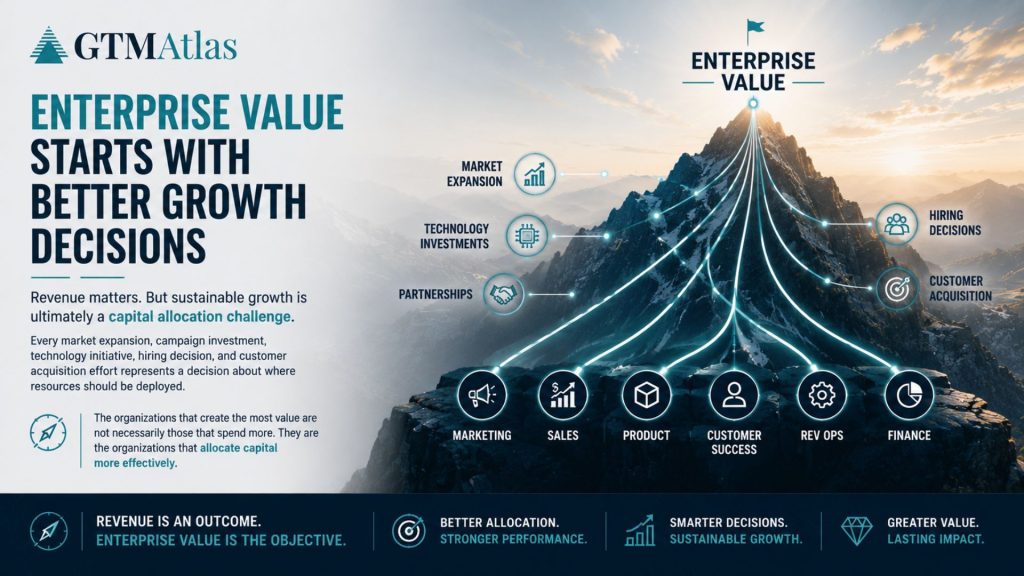
Growth is ultimately a capital allocation challenge. In practice, every market expansion, campaign investment, technology initiative, partnership strategy, hiring decision, and customer acquisition effort represents a choice about where resources should be deployed.
The organizations that create sustainable growth are not necessarily those that spend more.
They are often the organizations that allocate capital more effectively.
When GTM decisions become connected to financial outcomes, organizations improve not only revenue performance but also profitability, efficiency, resilience, and long-term enterprise value.
What the Future GTM Operating Model Requires
At GTMAtlas, we believe the future GTM Operating Model will be defined by four interconnected principles.
- First, growth decisions must be grounded in market evidence rather than assumptions.
- Second, organizations must expand their intelligence beyond internal performance metrics and continuously interpret signals from customers, competitors, investors, analysts, partners, technology shifts, and broader market dynamics.
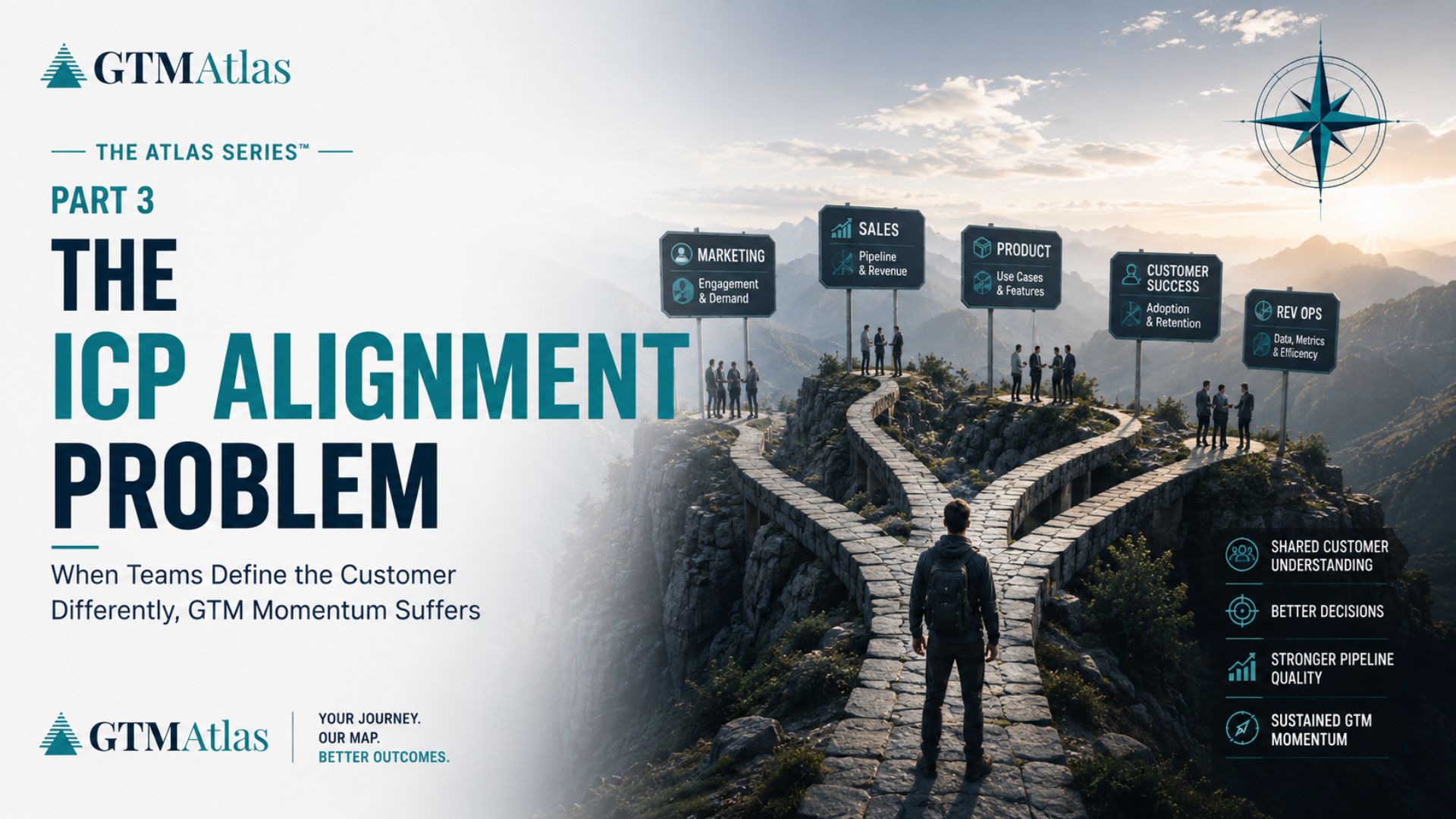
- Third, organizations must mitigate the ICP Alignment Gap and establish a shared understanding of the customers they serve.
- Fourth, growth decisions must be connected to financial outcomes and enterprise value creation rather than measured exclusively through activity and revenue metrics.
Collectively, these principles create a more adaptive operating model - specifically, one capable of sensing change earlier, allocating resources more effectively, orchestrating execution with greater precision, and maintaining momentum through uncertainty.
The objective is not simply to create a more aligned revenue organization. Rather, the objective is to create a more intelligent enterprise.
Keeping the GTM Journey in Motion
Throughout this series, we have explored why momentum breaks. Specifically, we examined how assumptions weaken strategy, how misalignment fragments execution, how inconsistent customer definitions create friction, and how incomplete signals distort market decisions.
Yet perhaps the most important realization is this: Momentum is not created by any individual function. Instead, it emerges from the quality of decisions an organization makes and the speed at which those decisions are translated into coordinated action.
That is why the future of GTM is unlikely to be defined by additional processes, more technology, or larger teams alone. Ultimately, it will be defined by the ability to continuously interpret market reality, align around evidence, govern decisions intelligently, and execute with confidence.
Looking Ahead
Theme 1 of The Atlas Series explored a fundamental challenge facing modern organizations: how to maintain momentum from strategic clarity to market execution. Moving forward, however, another question remains.
How can organizations create greater certainty before critical growth decisions are made?
That question will become the focus of the next Atlas Series.
In an increasingly complex market environment, sustainable growth belongs to organizations capable of transforming uncertainty into strategic confidence.
The GTMAtlas Perspective
Organizations do not maintain GTM momentum by optimizing individual functions. They maintain momentum by continuously improving the quality of enterprise growth decisions.