Executive Takeaways
- The primary drag on go-to-market (GTM) momentum is the growing gap between a documented Ideal Customer Profile and the divergent ways individual teams interpret and act upon it.
- Each department naturally optimizes around its own perspective and metrics, causing gradual strategic drift.
- Misalignment rarely manifests as an obvious, single execution failure. It creates compounding micro-inefficiencies: rising Customer Acquisition Costs (CAC), inconsistent pipeline quality, longer sales cycles, and unpredictable churn.
- Data fragmentation across departments prevents leadership from seeing a unified customer journey, masking the root cause of underperformance.
- High-growth organizations do not treat the ICP as a one-time strategy document. They treat ICP alignment as a continuous operating discipline.
- Maintaining alignment requires establishing shared customer terminology, cross-functional feedback mechanisms, and unified performance metrics across Marketing, Sales, Product, Customer Success, RevOps, and Finance.
Every leadership team believes they understand their customer.
The ideal customer profile has been documented. Target segments have been identified. Marketing campaigns are aligned to buyer personas. Sales teams have account priorities. Product teams have customer requirements. Customer Success has retention strategies.
On the surface, everything appears aligned.
Then something unexpected happens.
Marketing begins questioning why qualified leads are not converting.
Sales teams challenge the quality of opportunities entering the pipeline.
Product teams receive customer feedback that seems inconsistent with strategic priorities.
Customer Success struggles to drive adoption among newly acquired accounts.
Leadership teams receive conflicting signals about market performance and begin asking a familiar question:
“If we all agree on who our customer is, why are we seeing such different outcomes?”
The answer often reveals one of the most overlooked challenges in modern go-to-market execution.
Most organizations do not have an ICP definition problem.
They have an ICP alignment problem.
More specifically, they suffer from what we call the ICP Alignment Problem: the growing gap between a documented customer profile and the different ways teams interpret and act upon it.
It is within this gap that GTM momentum begins to slow, execution becomes fragmented, and growth becomes increasingly difficult to sustain.
The Hidden Cost of Customer Misalignment
When organizations evaluate growth challenges, they typically focus on market conditions, competitive pressures, product capabilities, or execution performance.
In reality, another factor frequently goes unnoticed.
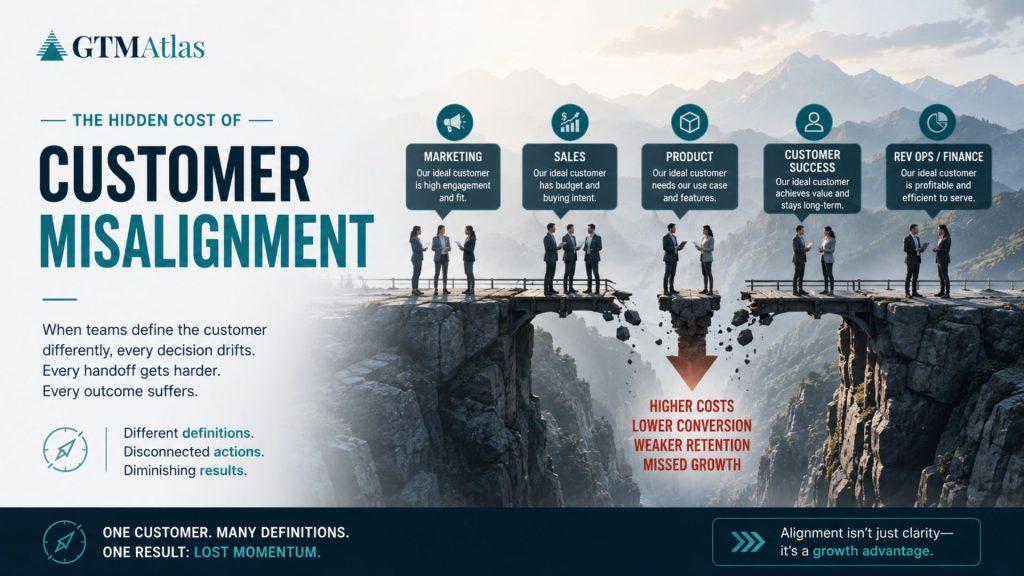
Every go-to-market function develops its own perspective on the customer.
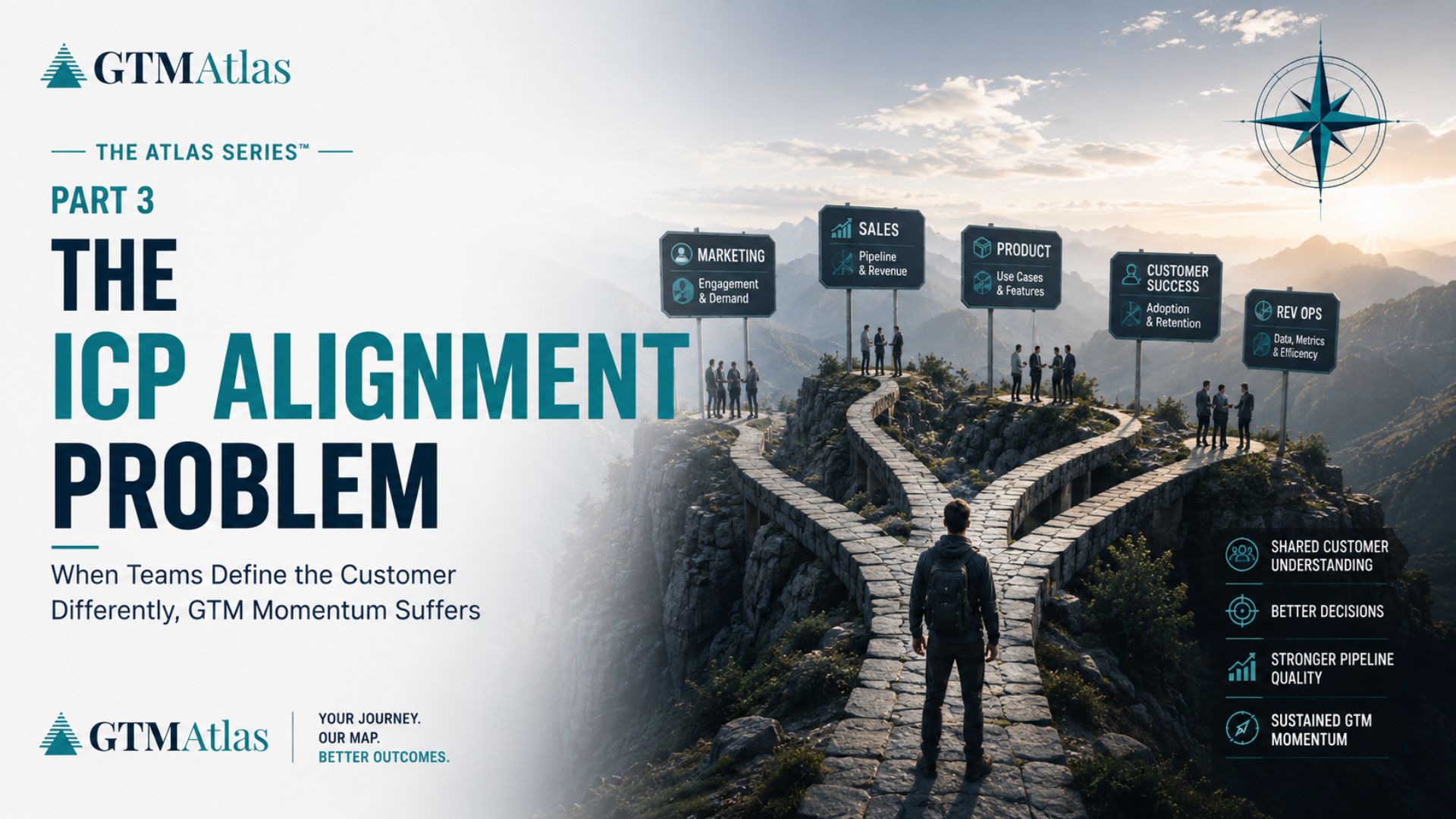
Marketing often prioritizes engagement potential. Sales focuses on revenue opportunities. Product concentrates on customer needs and use cases. Customer Success emphasizes retention and expansion potential. Revenue Operations analyzes performance through data and measurement.
Individually, these perspectives are logical.
Collectively, they can create friction.
Over time, each function begins optimizing around a slightly different version of the customer. Marketing attracts one audience. Sales pursues another. Product builds for a third. Customer Success supports a fourth.
No major decision causes the divergence. It emerges gradually through everyday choices, priorities, and incentives.
Unlike obvious execution failures, customer misalignment rarely announces itself. It appears through small inefficiencies that compound over time. Campaign performance becomes harder to predict. Pipeline quality becomes inconsistent. Customer acquisition costs rise. Retention outcomes vary across segments.
Each issue may seem isolated.
Together, they create organizational drag.
The market, meanwhile, continues moving.
Customers evolve. Buying behaviors change. Competitive alternatives expand. New opportunities emerge. By the time organizations recognize the extent of internal misalignment, they often discover they have spent months pursuing growth without a shared understanding of who they are trying to grow with.
This is why customer alignment is no longer simply a marketing exercise.
It has become a strategic growth capability.
Why ICP Alignment Has Become More Difficult
For many organizations, customer alignment was once relatively straightforward.
Markets were more stable. Buying journeys were more predictable. Customer segments changed gradually. Teams could operate with minor differences in interpretation without creating significant consequences.
That environment no longer exists.
Today’s customers are more informed, more selective, and often more difficult to categorize. Buying decisions involve larger stakeholder groups, longer evaluation cycles, and increasingly complex requirements.
As markets become more dynamic, maintaining alignment around the customer becomes significantly harder.
One reason is that market conditions evolve faster than most customer models. Organizations frequently define an ICP at the beginning of a strategic planning cycle, only to discover months later that customer priorities have shifted. Different functions respond independently, creating multiple interpretations of the market.
Another challenge comes from local optimization. Every function is measured differently. Marketing focuses on engagement and pipeline creation. Sales focuses on bookings. The product focuses on adoption. Customer Success focuses on retention and expansion. These metrics influence how teams prioritize customers and opportunities.
The result is often a subtle but meaningful drift.
Data fragmentation creates an additional challenge. Every team interacts with customers through a different lens. Marketing sees campaign behavior. Sales sees buying intent. Product sees usage patterns. Customer Success sees adoption and retention signals.
Each team possesses valuable insights.
Few organizations effectively combine those insights into a single customer narrative.
As a result, alignment becomes increasingly difficult precisely when it becomes most important.
Where Alignment Quietly Breaks Down
The ICP Alignment Problem rarely emerges from a single failure. More often, it develops through a series of disconnects that accumulate across the organization.
One of the most common breakdowns occurs between Marketing and Sales. Marketing generates leads that align with campaign objectives and targeting criteria. Sales evaluates opportunities based on buying readiness, budget availability, and revenue potential. Both teams may be following established processes, yet both may be operating from different interpretations of what constitutes an ideal customer.
Product alignment presents another challenge. Product teams continuously balance customer feedback, market trends, innovation priorities, and technical constraints. Meanwhile, Sales teams engage prospects facing immediate business challenges. When customer definitions diverge, product investments and market opportunities can begin moving in different directions.
Customer Success often experiences the consequences of these disconnects most directly. Customers acquired through misaligned targeting frequently require greater support, experience a slower time-to-value, and generate weaker retention outcomes. What initially appeared to be a successful acquisition may ultimately prove to be a poor fit.
Leadership visibility can also suffer. Different functions report different performance indicators, creating conflicting views of market reality. Marketing reports strong engagement. Sales reports show inconsistent conversion. Customer Success reports adoption challenges. Product reports growing feature demand.
Each perspective may be accurate.
The challenge is that they are describing different versions of the customer journey.
Over time, coordination becomes more difficult. Decisions take longer. Priorities become harder to align. Momentum begins to fade.
Not because teams lack capability.
Because teams lack a shared customer definition.
The Shift from ICP Definition to ICP Alignment
Many organizations approach ICP development as a one-time strategic exercise.
A cross-functional team conducts research, analyzes data, identifies target characteristics, and documents an Ideal Customer Profile. Once completed, the assumption is that alignment has been achieved.
The reality is far more complex.
Defining the customer is not the same as aligning around the customer.
High-performing organizations understand this distinction. They recognize that customer alignment is not a document. It is an operating discipline.
Rather than treating ICP development as a periodic project, they treat customer alignment as an ongoing organizational capability. They create regular mechanisms for reviewing customer insights, validating assumptions, and ensuring that every function operates from the same understanding of market opportunity.
The organizations establish a shared language across teams. They align metrics and decision-making processes. Such organizations continuously test whether their customer definitions still reflect market realities.
Most importantly, they recognize that alignment is not achieved once.
It must be maintained.
This shift fundamentally changes how organizations execute go-to-market strategies. Instead of allowing functions to develop independent customer perspectives, they create a coordinated view that guides decisions across the entire revenue organization.
The result is not simply better targeting.
It is a better execution.
Keeping the GTM Journey Moving
At GTMAtlas, we believe sustained growth requires more than strategic clarity.
It requires customer clarity.
Organizations can build sophisticated GTM strategies, invest in advanced technologies, and hire exceptional talent. Yet if core functions operate from different definitions of the customer, execution friction inevitably follows.
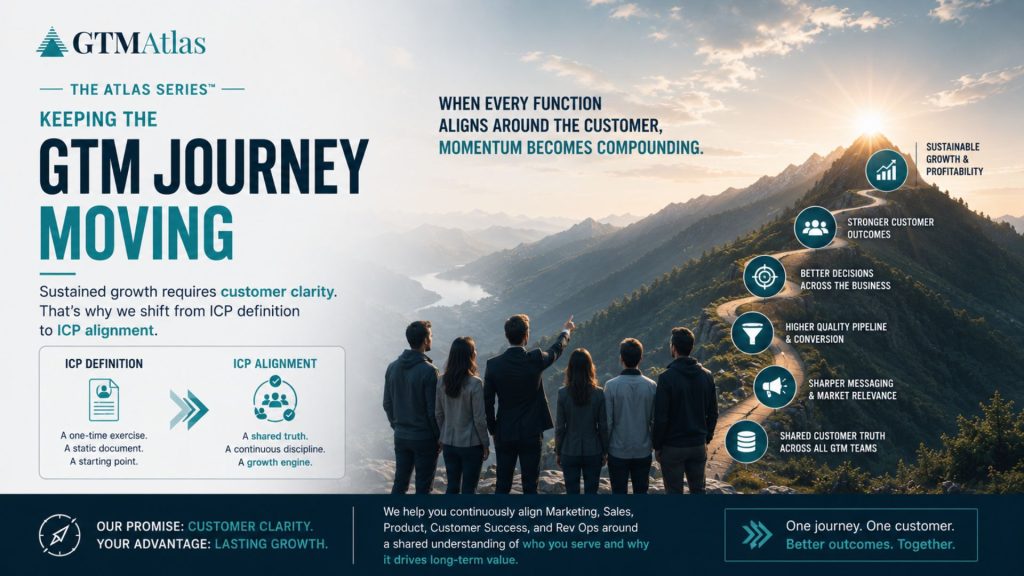
When organizations align around a shared understanding of the customer, the benefits extend far beyond marketing effectiveness.
Messaging becomes more relevant because teams are speaking to the same audience.
Pipeline quality improves because opportunities align with strategic priorities.
Product investments become more focused because customer needs are understood consistently.
Customer outcomes strengthen because acquired accounts are better positioned for long-term success.
Most importantly, teams move faster because they are moving in the same direction.
Alignment reduces friction. Reduced friction preserves momentum. Sustained momentum creates the conditions for predictable growth.
The objective is not simply to define the customer.
The objective is to ensure the entire organization is aligned around that definition.
The Path Forward
Every organization develops assumptions about its customers.
The difference between organizations that struggle and organizations that grow is not whether those assumptions exist. It is whether they remain aligned around them as markets evolve.
The organizations that will outperform in the years ahead will not simply be those with the most detailed customer profiles. They will be the organizations that continuously align Marketing, Sales, Product, Customer Success, and Revenue Operations around a shared understanding of who they serve and why they matter.
Because organizations rarely lose momentum when teams stop working.
They lose momentum when teams begin working toward different versions of the customer.
Customer alignment creates focus.
Focus creates coordination.
Coordination sustains momentum.
And momentum is what ultimately transforms strategy into growth.
Next in The Atlas Series: The Market Selection Trap — Choosing Where to Play Before Deciding How to Win